Showing posts with label threat. Show all posts

Wednesday, September 23, 2015

Is Your DNS Vulnerable?

This article originally appeared on F5.com on 7.29.15.

A recent report from The Infoblox DNS Threat Index (in conjunction with Internet Identity) shows that phishing attacks has raised the DNS threat level to a record high of 133 for second quarter of 2015, up 58% from the same time last year. The biggest factor for the jump is the creation of malicious domains for phishing attacks. Malicious domains are all those very believable but fake sites that are used to mimic real sites to get you to enter sensitive details. You get a phishing email, you click the link and get sent to a financial site that looks and operates just like your real bank site. If you're fooled and enter your credentials or other personal information, you could be giving the bad guys direct access to your money. These sites can also pretend to be corporate portals to gather employee credentials for future attacks.

Along with the malicious domains, demand for exploit kits also helped propel the DNS threat. Exploit kits are those wonderful packaged software that can run, hidden, on websites and load nasty controls and sniffers on your computer without you even knowing.

The Infoblox DNS Threat Index has a baseline of 100, which is essentially the quarterly averages over 2013 and 2014. In the first quarter 2015, the threat index jumped to 122 and then another 11 ticks for Q2 2015, hitting the high mark. Phishing was up by 74% in the second quarter and Rod Rasmussen, CTO at IID, noted that they saw a lot of phishing domains put up in the second quarter. You'd think after all these years this old trick would die but it is still very successful for criminals and with domain names costing less than $20 and available in minutes, it is a cheap investment for a potentially that big score.

DNS is what translates the names we type into a browser (or mobile app, etc.) into an IP address so that the resource can be found on the internet. It is one of the most important components to a functioning internet and as I've noted on several occasions, something you really do not think about until it isn't working...or is hacked. Second to http, DNS is one of the most targeted protocols and is often the source of many attacks. This year alone,  the St. Louis Federal Reserve suffered a DNS breach, Malaysia Airlines' DNS was hacked, and Lenovo.com to name a few. In addition, new exploits are surfacing targeting vulnerable home network routers to divert people to fake websites and DNS DDoS is always a favorite for riff-raff. Just yesterday 3 people were sent to prison in the DNS Changer Case.

DIAG-SOL-AVAIL-10819-DNS

With more insecure IoT devices coming on line and relying on DNS for resolution, this could be the beginning of a wave of DNS related incidents. But it doesn't have to be. DNS will become even more critical as additional IoT devices are connected and we want to find them by name. F5 DNS Solutions, especially DNSSEC solutions, can help you manage this rapid growth with complete solutions that increase the speed, availability, scalability, overall security and intelligently manages global app traffic. At F5 we are so passionate about DNS hyperscale and security that we are now even more focused with our new BIG-IP DNS (formerly BIG-IP GTM) solution.

ps

@psilvas

Related:

Connect with Peter: Connect with F5:
o_linkedin[1] o_rss[1] o_twitter[1]   o_facebook[1] o_twitter[1] o_slideshare[1] o_youtube[1]

Wednesday, March 26, 2014

Malware costs $491 Billion in Perspective

A recent joint study from IDC and the National University of Singapore (NUS) predicts that companies around the globe will spend around $491 billion in 2014 for fixes and recovery from data breaches and malware. The sponsor, Microsoft, also noted that pirated software tweaked with intent is a common method of getting inside. Consumers will likely spend $25 billion as a result of those security threats. $491 billion is a lot of change and in the spirit of Mobile Threats Rise 261% in Perspective, I wanted to know what else costs $491 billion.

Apparently, quite a few things!

U.S. motorists may spend a record $491 billion for gasoline this year. Expensive oil and increased exports have kept our fuel prices high this year. We are still under the 2008 average gas price record but we will still spend more due to gas going up sooner in the year and staying high longer. I know I've seen $4.11 here in California where the average is $3.94. While the winter blend production does bring some relief, don't expect major drops due to higher global demand along with the various feuds in the world.

Back in 2005, the US House of Representatives passed a $491 billion defense bill. This was when we were still in Iraq and the only reason I find this interesting is that the cyber-war can now cost as much as real wars. Not really apple to apples admittedly, but I often talk about how our digital worlds are colliding integrating with our physical lives. Either way, the costs can be very real.

Now at the 3 year mark of the Fukushima meltdown, property damage so far has been assessed at approximately US$200 billion but some estimates show that the total burden will be $491 billion. While one could never put a price on the 19,000 people lost from the earthquake and tsunami, it is kinda spooky that breaches and malware are on par with nuclear disasters.

According to the Global Business Travel Association (GBTA) Foundation business travel was responsible for about 3% of U.S. GDP in 2012 or $491 billion. Essentially, every dollar of business travel spending generated about $1.28 in GDP. Of the $491 billion total, $208 billion accrued directly to businesses that served travelers or meeting attendees.

In 2011 the European chemical industry contributed to 20.9% of the world’s chemical sales valued at €2353 billion, generating € 491 billion of revenues and employing 1.16 million people.

In 2012-13, India's total imports was $491 billion according to their Finance Minister.

And finally, the Earth is 491 billion feet from sun, give or take.

The malware market is on par with the likes of defense budgets, nuclear disasters, overall energy consumption and an entire country's import bill. It is often hard to quantify such large dollar amounts but when compared to the other $491 billion items, you can get a real sense of the magnitude.

ps


Connect with Peter: Connect with F5:
o_linkedin[1] o_rss[1] o_twitter[1]   o_facebook[1] o_twitter[1] o_slideshare[1] o_youtube[1]

Thursday, December 5, 2013

The Top 10, Top 10 Predictions for 2014

This time of year the crystal balls get a viewing and many pundits put out their annual predictions for the coming year.  Rather than thinking up my own, I figured I’d regurgitate what many others are expecting to happen.


Cybersecurity in 2014: A roundup of predictions: ZDNet might have picked up that I have done this for the past two years and Charles McLellan put together his own collection.  This is a good place to start with lists from Symantec, Websense, FireEye, Fortinet and others.  Mobile malware, zero-days, encryption, 'Internet of Things,' and a personal favorite, The Importance of DNS are amongst many predictions.

Eyes on the cloud: Six predictions for 2014: Kent Landry - Senior Consultant at Windstream focuses on Cloud futures in this Help Net Security piece.  Hybrid cloud, mobility and that pesky Internet of Everything make the list.

5 key information security predictions for 2014: InformationWeek has Tarun Kaura, Director, Technology Sales, Symantec discuss the coming enterprise threats for 2014.  Social Networking, targeted attacks, cloud and yet again, The Internet of Things finds a spot.

Top 10 Security Threat Predictions for 2014: This is essentially a slide show of Fortinet's predictions on Channel Partners Telecom but good to review.  Android malware, increased encryption, and a couple botnet predictions are included.

2014 Cyber Security Forecast: Significant healthcare trends: HealthITSecurity drops some security trends for healthcare IT security professionals in 2014.  Interesting take on areas like standards, audit committees, malicious insiders and supply chain are detailed.

14 IT security predictions for 2014: RealBusiness covers 10 major security threats along with four ways in which defenses will evolve.  Botnets, BYOD, infrastructure attacks and of course, the Internet of Things.

4 Predictions for 2014 Networks: From EETimes, this short list looks at the carrier network concerns.   Mobile AAA, NFV, 5G and once again, the Internet of Things gets exposure.

8 cyber security predictions for 2014: InformationAge goes full cybercriminal with exploits, data destruction, weakest links along with some 'offensive' or retaliatory attack information.

Verizon's 2014 tech predictions for the enterprise: Another ZDNet article covering the key trends Verizon believes will brand technology.  Interest includes the customer experience, IT decentralization, cloud and machine-to-machine solutions. 

Research: 41 percent increasing IT security budget in 2014: While not a list of predictions, this article covers a recent Tech Pro Research survey findings focused on IT security.  The report, IT Security: Concerns, budgets, trends and plans, noted that 41 percent of survey respondents said they will increase their IT security budget next year.  Probably to counter all the dire predictions.

A lot to consider as you toast the new year with the Internet of Things making many lists.  The key is to examine your own business and determine your own risks for 2014 and tackle those first.

ps

Related:


Connect with Peter: Connect with F5:
o_linkedin[1] o_rss[1] o_twitter[1]   o_facebook[1] o_twitter[1] o_slideshare[1] o_youtube[1]

Tuesday, September 10, 2013

The Malware Mess

A couple weeks ago McAfee Labs released the McAfee Threats Report: Second Quarter 2013, which found that Android-based malware marked a 35% growth rate not seen since early 2012.  They also found twice as many new ransomware offerings in Q2 as in Q1, bringing the 2013 ransomware count higher than the total found in all previous periods combined.  Everything was in play - SMS stealing bank malware, infected legitimate apps, malicious apps in sheep's clothing, along with fake dating and entertainments apps.  A lot of areas that we spend a good portion of our mobile time.

In addition to mobile threats, Q2 also saw a 16% uptick in suspicious URLs and a 50% increase in digitally-signed malware samples.  Attackers are showing that they can adapt to the criminal opportunities and continue to infiltrate the ever changing infrastructure.  Ransomware, a very popular and profitable scheme, where pop-ups or other messages threaten the user unless they pay a ransom, doubled from Q1 to Q2.  Hey, if it works, might as well.  Malware signed with legitimate certificates increased 50% to 1.2 million samples.  You think you're getting the safe code due to the certificate's authentication but that cozy blanket gets cold quick.  Malware also continues to find life with infected URLs according to McAfee.  The total number of suspect URLs found reached 74.7 million or a 16% increase over Q1.  The Indexed Web is at least 3.82 billion pages so around 2% of the web but still.  I might suggest, 'watch what you type, don't click suspicious links, avoid porn sites,' and other rather obvious actions but these days it could be delivered through an ad loading on a popular news site.  Almost no one is immune.  SPAM continues to hog email servers accounting for almost 70% of all global email volume.  That's nuts.  Think about it all the legitimate email we send over a month and it only accounts for 30% of all email?!?  What a waste of resources.  Other highlights included cyber espionage campaigns and attacks on digital currency.

These threats come at a time where there seems to be a disconnect between executives and their technical teams. 

The Ponemon Institute's most recent research shows that when it comes to locking down enterprise infrastructure, the application layer is responsible for more than 90% of all security vulnerabilities, yet more than 80% of IT security spending continues to be at the network and endpoint layer.  According to Ponemon, 'Most Organizations are Woefully Behind in Application Security.'  For it's 'Current State of Application Security Report' , they asked 642 IT professionals (both executive & engineering) 20 questions concerning tools usage, development team knowledge and security best practices to better understand the maturity of an organization’s application security program in comparison to the core competencies of high-performing organizations.  They found that a much higher percentage of executive-level respondents believe their organizations are following security procedures through the lifecycle of application development than do the engineers who are closest to executing the security processes.  For instance, 71% of executives interviewed believe that application security training is available and up to date but only 20% of technical staff felt the same.  Around 67% of execs feel they have a mature application security program, compared to 33% of technical staff and 75% of executives believe that a secure architecture exists in their organization verses 23% of technical staff.  Someone is either not communicating or many organizations do not yet consider the need to proactively do something about application security or even attempt to understand application security risks.

What is troublesome is that even with all the media attention and the afore mentioned malware stats, most organizations are not building nor testing their applications for security. According to the Ponemon report, only 43% of respondents say they have a process in place to test for vulnerabilities prior to release, and only 41% are using automated scanning tools to test applications during development. And just to pile on, only 42% push their applications to manual penetration testing by internal teams or from a third party. 

So, threats are increasing (I feel like I say this multiple times a year) and it seems that organizations' response to them are decreasing...or at least not taking them seriously enough.  In many ways, it is kinda like the real world.  We think, feel, believe that we're safe until something happens...then we take all the precautions.  Many organizations need to do that yesterday. 

Today's technologies are awesome but every once in a while I do miss 4 TV stations (including PBS), typewriters, rotary phones, mimeograph machines, S&H Green Stamps and the hard wires of yesteryear.

ps

Related:


Connect with Peter: Connect with F5:
o_linkedin[1] o_rss[1] o_twitter[1]   o_facebook[1] o_twitter[1] o_slideshare[1] o_youtube[1]

Wednesday, September 12, 2012

SmartTV, Smartphones and Fill-in-the-Blank Employees

Right off the bat, I know the title sounds like it’s all connected but they are only slightly related so I’ll give you the option of dropping out now.  Still here?  Cool.  I’ve been traveling over the last couple weeks and stories catch my eye along the way that I probably would’ve written about but didn’t.  Until now.  Besides it’s always fun to roll up a few stories in one to get back on track. 

TV’s are becoming cutting edge multimedia devices that reside on your living room wall.  You can stream movies, browse the web, check weather, plug in USBs for slideshows/video, play games, home network along with simply catching the latest episode of your favorite program.  This article from usatoday.com talks about many of the internet enabled TVs and their capabilities.  For instance, some TVs are now including dual-core processors to make web browsing more enjoyable since many TVs don’t have the processing power to load web pages quickly, or at least what we’re used to on our computers.  Also coming out are TVs with screen resolutions four times greater than full HD screens – these are the 4K sets.  These new 4K sets apparently has dampened any lingering 3D enthusiasm, which seems waning anyway.  In addition to TVs, other appliances are getting smart, so they say.  There are new refrigerators, air conditioners, washers, and dryers which are all app-controlled.  Users can turn them on and off from anywhere.  I know there are mobile ‘apps’ but it would be a easy transition to start calling our appliances, apps also.  Close enough.  How’s the clothes cleaning app working?  Is the food cooling app running?  I’ve mentioned many times that while all this is very cool stuff, we still need to remember that these devices are connected to the internet and subject to the same threats as all our other connected devices.  It’s only a matter of time when a hacker takes down all the ‘smart’ refrigerators on the East Coast.  I also think that TVs, cars and any other connected device could be considered BYOD in the near future.  Why wouldn’t a mobile employee want secure VDI access from his car’s Ent/GPS display?  Why couldn’t someone check their corporate email from the TV during commercials?

Smartphones, as most of you are aware, are changing our lives.  Duh.  There is an interesting series over on cnn.com called, "Our Mobile Society," about how smartphones and tablets have changed the way we live.  The first two articles, How smartphones make us superhuman and On second thought: Maybe smartphones make us 'SuperStupid'? cover both sides of the societal dilemma.  In 2011, there were 6 Billion mobile phone subscriptions worldwide servicing the 7 Billion people who live on this planet, according to the International Telecommunication Union.  These connected devices have made trivia, trivial and we can keep in constant contact with everyone along with people driving, texting and generally not paying attention to anything around them while interacting with their appendage.  Pew also released a survey indicating that 54% of cell phone consumers who use mobile apps have decided not to install an app after learning how much personal information they'd have to share; and 30% of that group has uninstalled an app for privacy reasons.  We are so concerned about our privacy that we’re now dumping apps that ask for too much info.  I know there is a ‘We all have one & use it everyday day but don’t look, ok’ joke somewhere in there.

To Educate or Not Educate.  I have no idea why I only saw this recently but back in July, there was a lively discussion about whether security awareness training for employees was money well spent.   I’ve often written about the importance of ongoing training.  In Why you shouldn't train employees for security awareness, Dave Aitel argues that even with all that  training, employees still click malicious links anyway.  Instead of wasting money on employee training, organizations should bolster up their system’s defenses to protect employees from themselves.  Boris Sverdlik of Jaded Security posted a rebuttal saying that employees are and should be accountable for what happens in the environment and no amount of controls can protect against people spilling secrets during a social engineering probe.  In a rebuttal to both, Iftach Ian Amit, from Security Art says they are both right and wrong at the same time.  He states, ‘Trying to solve infosec issues through technological means is a guaranteed recipe for failure. No one, no technology, or software can account for every threat scenario possible, and this is exactly why we layer our defenses. And layering shouldn’t just be done from a network or software perspective – security layers also include access control, monitoring, tracking, analysis, and yes – human awareness. Without the human factor you are doomed.’  His position is that when it comes to ‘Information Security,’ we focus too much on the ‘information’ part and less on the holistic meaning of ‘security.’  His suggestion is to look at your organization as an attacker would and invest in areas that are vulnerable.  That’s your basic risk analysis and risk mitigation.

We are in a fun time for technology, enjoy and use wisely.

ps

References

Technorati Tags: F5, data breach report, threats, Pete Silva, security, malware, technology, smartphone, cyber-threat, social engineering, attacks, virus, vulnerability, web, internet, cybercrime, identity theft, scam, data breach,

Connect with Peter: Connect with F5:
o_linkedin[1] o_rss[1] o_facebook[1] o_twitter[1]   o_facebook[1] o_twitter[1] o_slideshare[1] o_youtube[1]

Wednesday, February 22, 2012

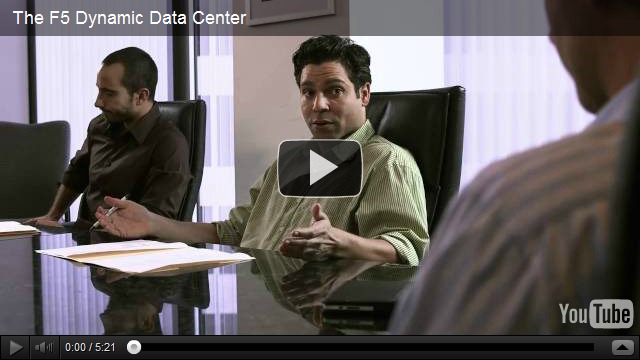
2011 Telly Award Winner - The F5 Dynamic Data Center

Founded in 1978 to honor excellence in local, regional, cable TV commercials along with non-broadcast video and TV programs, The Telly Awards is the premier award honoring the finest film and video productions, groundbreaking web commercials, videos and films, and outstanding local, regional, and cable TV commercials and programs.  Produced in conjunction with Connect Marketing, we are proud to share that F5’s video, The Dynamic Data Center, is a Silver Winner for the 32nd Annual Telly Awards.
 
This video sets the stage for IT having to manage multiple networking challenges when faced with a natural disaster causing their data center to shut down. With careful planning, the evolution of the network and application delivery allows the single point of control to automate, provision and secure their virtual and cloud environments.
The F5 Dynamic Data Center

ps

Resources:

Connect with Peter: Connect with F5:
o_linkedin[1] o_rss[1] o_facebook[1] o_twitter[1]   o_facebook[1] o_twitter[1] o_slideshare[1] o_youtube[1]

Monday, August 15, 2011

Audio White Paper - Application Security in the Cloud with BIG-IP ASM

Application threats are constantly evolving. Recent high-profile Internet attacks on organizations like HBGary, RSA, WikiLeaks, Google, Comodo, and others prove that no one is immune. Anyone could be a target, and perpetrators are extremely organized, skilled, and well-funded. Culprits are often better trained than the IT staff deployed to thwart the attacks, which are targeted, elaborate, and aggressive—not to mention creative. The attacks are multi-layered and constant, and seek not only to deface a website, but to steal valuable data. Customer data, intellectual property, state secrets, SSL certificates, and other proprietary, highly sensitive information are the top targets.  Whether critical applications live in the cloud, in the data center, or in both, organizations need a strategic point of control for application security. F5 BIG-IP Application Security Manager (ASM) provides the security, intelligence, and performance that today’s dynamic infrastructure demands.  Running Time: 20:26  Read full white paper here.  And click here for more F5 Audio.


ps

Technorati Tags: F5, integration, data center, Pete Silva, security, business, education, technology, application delivery, waf, cloud, asm, dynamic, web, internet, security, hardware, audio, whitepaper, big-ip

Connect with Peter: Connect with F5:
o_linkedin[1] o_rss[1] o_facebook[1] o_twitter[1] o_facebook[1] o_twitter[1] o_slideshare[1] o_youtube[1]