What happens to your data once it’s been compromised by a phishing attack or data breach? In this episode Peter Silva explores where your data goes and how much it is worth once it’s stolen in a data breach or phishing attack.
If you're under attack, visit f5.com/sirt to get immediate help!
#f5Labs #90SecondsOfSecurity
Showing posts with label breach. Show all posts
Showing posts with label breach. Show all posts
Wednesday, January 29, 2020


Friday, December 13, 2019
F5 Cloud Services Early Access Program
F5's Cloud Services Team is excited to share an opportunity for
customers test two new technologies! Essential App Protect is an
instant, out-of-the-box protection from common web exploits, malicious
IPs and coordinated attack types. Bot Protect is a bot management SaaS
solution that identifies bots’ intent and prevents attacks, while
maintaining access for the good bots that help your business.
Visit: https://www.f5.com/preview to help shape our roadmap and influence feature development!
Visit: https://www.f5.com/preview to help shape our roadmap and influence feature development!
Friday, December 9, 2016
The Top 10, Top 10 Predictions for 2017

The
time of year when crystal balls get a viewing and many pundits put out their
annual predictions for the coming year. Rather than thinking up my own, I
figured I’d regurgitate what many others are expecting to happen.
8 Predictions About How the Security
Industry Will Fare in 2017 – An eWeek slideshow looking at areas like
IoT, ransomware, automated attacks and the security skills shortage in the
industry. Chris Preimesberger (@editingwhiz), who does a
monthly #eweekchat
on twitter, covers many of the worries facing organizations.
10 IoT Predictions for 2017 – IoT was
my number 1 in The
Top 10, Top 10 Predictions for 2016 and no doubt, IoT will continue to
cause havoc. People focus so much on the ‘things’ themselves rather than the
risk of an internet connection. This list discusses how IoT will grow up in
2017, how having a service component will be key, the complete mess of
standards and simply, ‘just because you
can connect something to the Internet doesn’t mean that you should.’
10 Cloud Computing Trends to Watch in 2017
- Talkin' Cloud posts Forrester’s list of cloud computing predictions for 2017
including how hyperconverged infrastructures will help private clouds get real,
ways to make cloud migration easier, the importance (or not) of megaclouds,
that hybrid cloud networking will remain the weakest link in the hybrid cloud
and that, finally, cloud service providers will design security into their
offerings. What a novel idea.
2017 Breach Predictions: The big one is
inevitable – While not a list, per se, NetworkWorld talks about how
we’ll see more intricate, complex and undetected data integrity attacks and for
two main reasons: financial gain and/or political manipulation. Political
manipulation? No, that’ll never happen. NW talks about how cyberattacks will
get worse due to IoT and gives some ideas on how to protect your data in 2017.
Catastrophic botnet to smash social media
networks in 2017 – At the halfway point the Mirai
botnet rears its ugly head and ZDNet explains how Mirai is far from the end
of social media disruption due to botnets. With botnets-for-hire
now available, there will be a significant uptick in social media botnets
which aim not only to disrupt but also to earn money for their operators in
2017. Splendid.
Torrid Networks’ Top 10 Cyber Security
Predictions For 2017 – Dhruv Soi
looks at the overall cyber security industry and shares that many security
product companies will add machine learning twist to their products and at
the same time, there will be next-gen malware with an ability to bypass machine
learning algorithms. He also talks about the fast adoption of Blockchain, the
shift towards mobile exploitation and the increase of cyber insurance in 2017.
Fortinet
2017 Cybersecurity Predictions: Accountability Takes the Stage - Derek Manky goes in depth
with this detailed article covering things like how IoT manufacturers will be
held accountable for security breaches, how attackers will begin to turn up the
heat in smart cities and if technology can close the gap on the critical cyber
skills shortage. Each of his 6 predictions include a detailed description along
with risks and potential solutions.
2017 Security Predictions – CIO
always has a year-end
prediction list and this year doesn’t disappoint. Rather than reviewing the
obvious, they focus on things like Dwell time, or the interval between a
successful attack and its discovery by the victim. In some cases, dwell times
can reach as high as two years! They also detail how passwords will eventually
grow up, how the security blame game will heat up and how mobile payments, too,
will become a liability. Little different take and a good read.
Predictions for DevOps in 2017 –
I’d be remiss if I didn’t include some prognosis about DevOps - one of the most
misunderstood terms and functions of late. For DevOps, they will start to
include security as part of development instead of an afterthought, we’ll see an
increase in the popularity of containerization solutions and DZone sees
DevOps principals moving to mainstream enterprise rather than one-off projects.
10 top holiday phishing scams –
While many of the lists are forward-looking into the New Year, this one dives
into the risks of the year end. Holiday shopping. A good list of holiday
threats to watch out for including fake purchase invoices, scam email deals,
fake surveys and shipping status malware messages begging you to click the
link. Some advice: Don’t!
Bonus Prediction!
Top 10 Most Popular Robots to Buy in 2017
– All kinds of robots are now entering our homes and appearing in society. From
vacuums to automated cars to drones to digital assistants, robots are
interacting with us more than ever. While many are for home use, some also help
with the disabled or help those suffering from various ailments like autism, a
stroke or even a missing limb. They go by many monikers like Asimo, Spot,
Moley, Pepper, Jibo and Milo to name a few.
Are you ready for 2017?
If you want to see if any of the
previous year’s prognoses came true, here ya go:
- The Top 10, Top 10 Predictions for
2016
- The Top 10, Top 10
Predictions for 2015
- The Top 10, Top 10
Predictions for 2014
- The Top 10, Top 10
2013 Predictions
- The Top 10, Top
Predictions for 2012
ps
Tuesday, July 19, 2016
Is 2016 Half Empty or Half Full?
Updating passwords is a huge trend in 2016
 With
2016 crossing the half way point, let's take a look at some technology trends
thus far.
Breaches: Well, many databases are half empty due to the continued rash of intrusions while the crooks are half full with our personal information. According to the Identity Theft Resource Center (ITRC), there have been 522 breaches thus far in 2016 exposing almost 13,000,000 records. Many are health care providers as our medical information is becoming the gold mine of stolen info. Not really surprising since the health care wearable market is set to explode in the coming years. Many of those wearables will be transmitting our health data back to providers. There were also a bunch of very recognizable names getting blasted in the media: IRS, Snapchat, Wendy’s and LinkedIn. And the best advice we got? Don’t use the same password across multiple sites. Updating passwords is a huge trend in 2016.
Cloud Computing: According to IDC, public cloud IaaS revenues are on pace to more than triple by 2020. From $12.6 billion in 2015 to $43.6 billion in 2020. The public cloud IaaS market grew 51% in 2015 but will slightly slow after 2017 as enterprises get past the wonder and move more towards cloud optimization rather than simply testing the waters. IDC also noted that four out of five IT organizations will be committed to hybrid architectures by 2018. While hybrid is the new normal remember, The Cloud is Still just a Datacenter Somewhere. Cloud seems to be more than half full and this comes at a time when ISO compliance in the cloud is becoming even more important.
DNS: I’ve said it before and I’ll say it again, DNS is one of the most important components of a functioning internet. With that, it presents unique challenges to organizations. Recently, Infoblox released its Q1 2016 Security Assessment Report and off the bat said, ‘In the first quarter of 2016, 519 files capturing DNS traffic were uploaded by 235 customers and prospects for security assessments by Infoblox. The results: 83% of all files uploaded showed evidence of suspicious activity (429 files).’ They list the specific threats from botnets to protocol anomalies to Zeus and DDoS. A 2014 vulnerability, Heartbleed, still appears around 11% of the time. DevOps is even in the DNS game. In half full news, VeriSign filed two patent applications describing the use of various DNS components to manage IoT devices. One is for systems and methods for establishing ownership and delegation of IoT devices using DNS services and the other is for systems and methods for registering, managing, and communicating with IoT devices using DNS processes. Find that half full smart mug...by name!
IoT: What can I say? The cup runneth over. Wearables are expected to close in on 215 million units shipped by 2020 with 102 million this year alone. I think that number is conservative with smart eyewear, watches and clothing grabbing consumer’s attention. Then there’s the whole realm of industrial solutions like smart tractors, HVAC systems and other sensors tied to smart offices, factories and cities. In fact, utilities are among the largest IoT spenders and will be the third-largest industry by expenditure in IoT products and services. Over $69 billion has already been spent worldwide, according to the IDC Energy Insights/Ericsson report. And we haven’t even touched on all the smart appliances, robots and media devices finding spots our homes. Get ready for Big Data regulations as more of our personal (and bodily) data gets pushed to the cloud. And we’re talking a lot of data.
Mobile: We are mobile, our devices are mobile and the applications we access are mobile. Mobility, in all its iterations, is a huge enabler and concern for enterprises and it'll only get worse as we start wearing our connected clothing to the office. The Digital Dress Code has emerged. With 5G on the way, mobile is certainly half full and there is no empting it now.
 Of
course, F5 has solutions to address many of
these challenges whether you’re boiling over or bone dry. Our security solutions, including Silverline, can protect against
malicious attacks; no matter the cloud - private, public or hybrid - our Cloud solutions can get you there
and back; BIG-IP
DNS, particularly DNS
Express, can handle the incredible name request boom as more ‘things’ get connected;
and speaking of things, your data
center will need to be agile enough to handle all the
nouns requesting access; and check out how TCP
Fast Open can optimize your mobile communications.
That's what I got so far and I'm sure 2016's second half will bring more amazement, questions and wonders. We'll do our year-end reviews and predictions for 2017 as we all lament, where did the Year of the Monkey go?
There's that old notion that if you see a glass half full, you're an optimist and if you see it half empty you are a pessimist. I think you need to understand what state the glass itself was before the question. Was it empty and filled half way or was it full and poured out? There's your answer!
ps

Breaches: Well, many databases are half empty due to the continued rash of intrusions while the crooks are half full with our personal information. According to the Identity Theft Resource Center (ITRC), there have been 522 breaches thus far in 2016 exposing almost 13,000,000 records. Many are health care providers as our medical information is becoming the gold mine of stolen info. Not really surprising since the health care wearable market is set to explode in the coming years. Many of those wearables will be transmitting our health data back to providers. There were also a bunch of very recognizable names getting blasted in the media: IRS, Snapchat, Wendy’s and LinkedIn. And the best advice we got? Don’t use the same password across multiple sites. Updating passwords is a huge trend in 2016.
Cloud Computing: According to IDC, public cloud IaaS revenues are on pace to more than triple by 2020. From $12.6 billion in 2015 to $43.6 billion in 2020. The public cloud IaaS market grew 51% in 2015 but will slightly slow after 2017 as enterprises get past the wonder and move more towards cloud optimization rather than simply testing the waters. IDC also noted that four out of five IT organizations will be committed to hybrid architectures by 2018. While hybrid is the new normal remember, The Cloud is Still just a Datacenter Somewhere. Cloud seems to be more than half full and this comes at a time when ISO compliance in the cloud is becoming even more important.
DNS: I’ve said it before and I’ll say it again, DNS is one of the most important components of a functioning internet. With that, it presents unique challenges to organizations. Recently, Infoblox released its Q1 2016 Security Assessment Report and off the bat said, ‘In the first quarter of 2016, 519 files capturing DNS traffic were uploaded by 235 customers and prospects for security assessments by Infoblox. The results: 83% of all files uploaded showed evidence of suspicious activity (429 files).’ They list the specific threats from botnets to protocol anomalies to Zeus and DDoS. A 2014 vulnerability, Heartbleed, still appears around 11% of the time. DevOps is even in the DNS game. In half full news, VeriSign filed two patent applications describing the use of various DNS components to manage IoT devices. One is for systems and methods for establishing ownership and delegation of IoT devices using DNS services and the other is for systems and methods for registering, managing, and communicating with IoT devices using DNS processes. Find that half full smart mug...by name!
IoT: What can I say? The cup runneth over. Wearables are expected to close in on 215 million units shipped by 2020 with 102 million this year alone. I think that number is conservative with smart eyewear, watches and clothing grabbing consumer’s attention. Then there’s the whole realm of industrial solutions like smart tractors, HVAC systems and other sensors tied to smart offices, factories and cities. In fact, utilities are among the largest IoT spenders and will be the third-largest industry by expenditure in IoT products and services. Over $69 billion has already been spent worldwide, according to the IDC Energy Insights/Ericsson report. And we haven’t even touched on all the smart appliances, robots and media devices finding spots our homes. Get ready for Big Data regulations as more of our personal (and bodily) data gets pushed to the cloud. And we’re talking a lot of data.
Mobile: We are mobile, our devices are mobile and the applications we access are mobile. Mobility, in all its iterations, is a huge enabler and concern for enterprises and it'll only get worse as we start wearing our connected clothing to the office. The Digital Dress Code has emerged. With 5G on the way, mobile is certainly half full and there is no empting it now.

That's what I got so far and I'm sure 2016's second half will bring more amazement, questions and wonders. We'll do our year-end reviews and predictions for 2017 as we all lament, where did the Year of the Monkey go?
There's that old notion that if you see a glass half full, you're an optimist and if you see it half empty you are a pessimist. I think you need to understand what state the glass itself was before the question. Was it empty and filled half way or was it full and poured out? There's your answer!
ps
Tuesday, November 17, 2015
Identity Theft: Not So Scary Anymore?
This article originally appeared on F5.com on 10.20.15.
With Halloween in our rearview mirror and the holiday shopping season upon us, a couple surveys are out examining our fears and in particular, our concerns about identity theft. Apparently, ID theft is not so scary anymore - like entering a haunted house for the hair-raising screams but walking out with nervous giggles.
Over at Bankrate.com, only 54% of surveyed tricksters says they are somewhat or very frightened of ID theft. That's down 80% from those who expressed the same level of concern back in 2008. Almost half, 43%, claim they have little or no fear, trouncing the 19% who were brave in 2008. This is all while the overall victim count remains at similar levels - 12.5 million in 2008 verses 12.7 million in 2014 according to Javelin Strategy & Research. As far as knowing someone who has been hit, 46% say they or a friend has been a victim compared to 34% in 2008.
They chalk it up to people being desensitized to breaches due to the almost weekly confessions of data intrusions. The general feeling is that if large retailers, health care providers and credit agencies can't keep my data safe, how can I. More of those same folks however are also following some good advice of shredding sensitive documents (72%), checking their credit report regularly (56%), avoiding insecure WiFi (54%) and almost 20% have frozen their credit files. These are all good ways to help you worry less.
And Chapman University published their Survey of American Fears, Wave 2 (2015) examining the fears of average Americans. The domains of fear include areas like crime, natural and man made disasters, personal anxieties, environment, technology and others. Along with the corruption, terrorism and warfare, identity theft comes in at 39.6% and credit card fraud sits at 36.9%. Both in the Top 10.
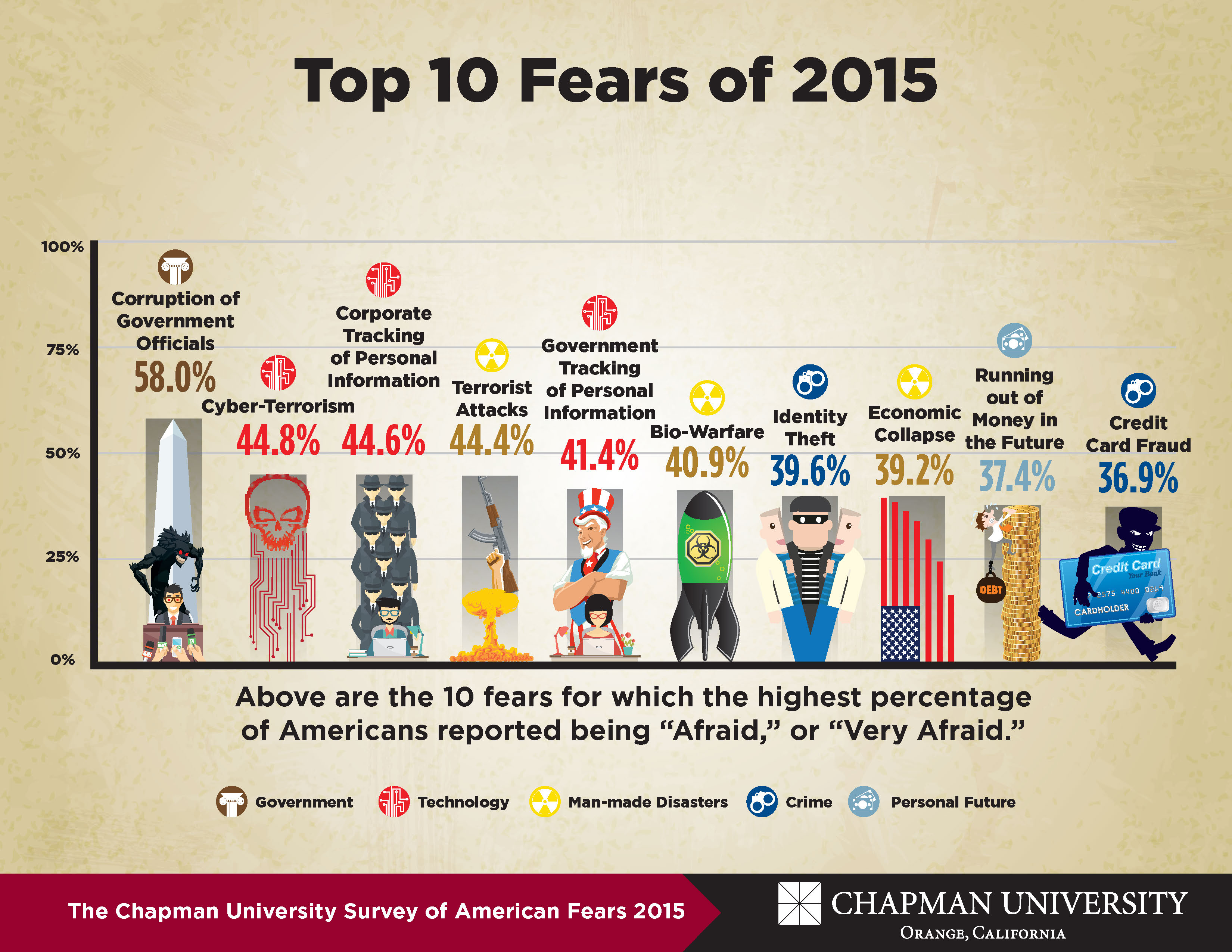
So, while ID theft is still one of our top fears, by the time you get to Nightmare on Identity Street 4, Freddy isn't so freighting and you have some tools to deal with him.
Besides, your insecure connected kettles could be exposing your WiFi passwords without your knowledge. Now that's scary!
ps
Related
With Halloween in our rearview mirror and the holiday shopping season upon us, a couple surveys are out examining our fears and in particular, our concerns about identity theft. Apparently, ID theft is not so scary anymore - like entering a haunted house for the hair-raising screams but walking out with nervous giggles.
Over at Bankrate.com, only 54% of surveyed tricksters says they are somewhat or very frightened of ID theft. That's down 80% from those who expressed the same level of concern back in 2008. Almost half, 43%, claim they have little or no fear, trouncing the 19% who were brave in 2008. This is all while the overall victim count remains at similar levels - 12.5 million in 2008 verses 12.7 million in 2014 according to Javelin Strategy & Research. As far as knowing someone who has been hit, 46% say they or a friend has been a victim compared to 34% in 2008.
They chalk it up to people being desensitized to breaches due to the almost weekly confessions of data intrusions. The general feeling is that if large retailers, health care providers and credit agencies can't keep my data safe, how can I. More of those same folks however are also following some good advice of shredding sensitive documents (72%), checking their credit report regularly (56%), avoiding insecure WiFi (54%) and almost 20% have frozen their credit files. These are all good ways to help you worry less.
And Chapman University published their Survey of American Fears, Wave 2 (2015) examining the fears of average Americans. The domains of fear include areas like crime, natural and man made disasters, personal anxieties, environment, technology and others. Along with the corruption, terrorism and warfare, identity theft comes in at 39.6% and credit card fraud sits at 36.9%. Both in the Top 10.
So, while ID theft is still one of our top fears, by the time you get to Nightmare on Identity Street 4, Freddy isn't so freighting and you have some tools to deal with him.
Besides, your insecure connected kettles could be exposing your WiFi passwords without your knowledge. Now that's scary!
ps
Related
- Survey: More Americans say 'boo' to the ID theft boogeyman
- America’s Top Fears 2015
- Connected kettles boil over, spill Wi-Fi passwords over London
- The Breach of Things
- The Reach of a Breach
- 5 Stages of a Data Breach
| Connect with Peter: | Connect with F5: |
   |    |
Wednesday, September 23, 2015
Is Your DNS Vulnerable?
This article originally appeared on F5.com on 7.29.15.
A recent report from The Infoblox DNS Threat Index (in conjunction with Internet Identity) shows that phishing attacks has raised the DNS threat level to a record high of 133 for second quarter of 2015, up 58% from the same time last year. The biggest factor for the jump is the creation of malicious domains for phishing attacks. Malicious domains are all those very believable but fake sites that are used to mimic real sites to get you to enter sensitive details. You get a phishing email, you click the link and get sent to a financial site that looks and operates just like your real bank site. If you're fooled and enter your credentials or other personal information, you could be giving the bad guys direct access to your money. These sites can also pretend to be corporate portals to gather employee credentials for future attacks.
Along with the malicious domains, demand for exploit kits also helped propel the DNS threat. Exploit kits are those wonderful packaged software that can run, hidden, on websites and load nasty controls and sniffers on your computer without you even knowing.
The Infoblox DNS Threat Index has a baseline of 100, which is essentially the quarterly averages over 2013 and 2014. In the first quarter 2015, the threat index jumped to 122 and then another 11 ticks for Q2 2015, hitting the high mark. Phishing was up by 74% in the second quarter and Rod Rasmussen, CTO at IID, noted that they saw a lot of phishing domains put up in the second quarter. You'd think after all these years this old trick would die but it is still very successful for criminals and with domain names costing less than $20 and available in minutes, it is a cheap investment for a potentially that big score.
DNS is what translates the names we type into a browser (or mobile app, etc.) into an IP address so that the resource can be found on the internet. It is one of the most important components to a functioning internet and as I've noted on several occasions, something you really do not think about until it isn't working...or is hacked. Second to http, DNS is one of the most targeted protocols and is often the source of many attacks. This year alone, the St. Louis Federal Reserve suffered a DNS breach, Malaysia Airlines' DNS was hacked, and Lenovo.com to name a few. In addition, new exploits are surfacing targeting vulnerable home network routers to divert people to fake websites and DNS DDoS is always a favorite for riff-raff. Just yesterday 3 people were sent to prison in the DNS Changer Case.

With more insecure IoT devices coming on line and relying on DNS for resolution, this could be the beginning of a wave of DNS related incidents. But it doesn't have to be. DNS will become even more critical as additional IoT devices are connected and we want to find them by name. F5 DNS Solutions, especially DNSSEC solutions, can help you manage this rapid growth with complete solutions that increase the speed, availability, scalability, overall security and intelligently manages global app traffic. At F5 we are so passionate about DNS hyperscale and security that we are now even more focused with our new BIG-IP DNS (formerly BIG-IP GTM) solution.
ps
@psilvas
Related:
- Phishing Attacks Drive Spike In DNS Threat
- The growing threat of DDoS attacks on DNS
- Infoblox DNS Threat Index Hits Record High in Second Quarter Due to Surge in Phishing Attacks
- Infoblox DNS Threat Index
- Eight Internet of Things Security Fails
- Intelligent DNS Animated Whiteboard (Video)
- CloudExpo 2014: The DNS of Things (Video)
- DNS Doldrums
| Connect with Peter: | Connect with F5: |
| | |
Wednesday, July 15, 2015
Is 2015 Half Empty or Half Full?
With 2015 crossing the half way point, let's take a look at some technology trends thus far.
Breaches: Well, many databases are half empty due to the continued rash of intrusions while the crooks are half full with our personal information. Data breaches are on a record pace this year and according to the Identity Theft Resource Center (ITRC), there have been 400 data incidents as of June 30, 2015. One more than this time last year. And, 117,576,693 records had been compromised. ITRC also noted a 85% increase in the number of breaches within the banking sector. From health care to government agencies to hotel chains to universities and even Major League Baseball, breaches and attacks are now a daily occurrence.
Cloud: Who would've thought back in 2008 that this cloud thing would now be half full? Over the last couple years, the 'cloud' has become a very viable option for organizations large and small. It is becoming the platform for IoT and many organizations such as Google and GE are now moving critical corporate applications to the cloud. While hybrid is the new normal remember, The Cloud is Still just a Datacenter Somewhere.
DNS: While IPv4 addresses are now completely empty, DNS seems to be half to almost full in 2015. DNS continues to be a target for attackers along with being an enabler for IoT. It is so important that Cisco recently acquired OpenDNS to help fight IoT attacks and the courts got a guilty plea from an Estonian man who altered DNS settings on infected PCs with the DNSChanger malware. I think of DNS as a silent sufferer - you really don't care about it until it doesn't work. Start caring this year.
Internet: Full but still growing. As noted above, IPv4 addresses are gone. Asia, Europe, Latin America and now North America have run out of IPv4 addresses and have exhausted their supplies. If you're wondering how to handle this glass, F5 has some awesome 4to6 and 6to4 solutions.
IoT: Things, sensors and actuators are all the buzz and are certainly half full for 2015. At this time last year, IoT was at the top of the Gartner Hype Cycle and it has certainly not disappointed. Stories abound about Internet of Things Security Risks and Challenges, 10 of the biggest IoT data generators, the Top 10 Worst Wearable Tech Devices So Far, The (Far-Flung) Future Of Wearables, along with the ability to Smell Virtual Environments and if We Need Universal Robot Rights, Ethics And Legislation. RoboEthics, that is.
Mobile: We are mobile, our devices are mobile and the applications we access are now probably mobile also. Mobility, in all it's connotations, is a huge concern for enterprises and it'll only get worse as we start wearing our connected clothing to the office. The Digital Dress Code has emerged. Mobile is certainly half full and there is no empting it now.
Privacy: At this point with all the surveillance, data breaches, gadgets gathering our daily data and our constant need to tell the world what we're doing every second, this is probably bone dry. Pardon, half empty, sticking to the theme.
That's what I got so far and I'm sure 2015's second half will bring more amazement, questions and wonders. We'll do our year in reviews and predictions for 2016 as we all lament, where did 2015 go? There is that old notion that if you see a glass half full, you're an optimist and if you see it half empty you are a pessimist. Actually, you need to understand what the glass itself was before the question. Was it empty and filled half way or was it full and poured out? There's you answer!
ps
Related:
- It's all contained within the blog.
| Connect with Peter: | Connect with F5: |
| | |
Wednesday, September 3, 2014
The Breach of Things
Yet another retailer has confessed that their systems were breached and an untold number of victims join the growing list of those who have had their data was stolen. This one could be bigger than the infamous Target breach. I wonder if some day we'll be referring to periods of time by the breach that occurred. 'What? You don't remember the Target breach of '13! Much smaller than the Insert Company Here Breach of 2019!' Or almost like battles of a long war. 'The Breach of 2013 was a turning point in the fight against online crime,' or some other silly notion.
On top of that, a number of celebrity's private photos, stored in the cloud (of course), were privately stolen. I'm sorry but if you are going to take private pictures of yourself with something other than a classic Polaroid, someone else will eventually see them.
Almost everything seems breach'able these days. Last year, the first toilet was breached. The one place you'd think you would have some privacy has also been soiled. Add to that televisions, thermostats, refrigerators and automobiles. And a person's info with a dangerous hug. Companies are sprouting up all over to offer connected homes where owners can control their water, temperature, doors, windows, lights and practically any other item, as long as it has a sensor. Won't be long until we see sensational headlines including 'West Coast Fridges Hacked...Food Spoiling All Over!' or 'All Eastern Televisions Hacked to Broadcast old Gilligan's Island Episodes!'
As more things get connected, the risks of a breach obviously increase. The more I thought about it, I felt it was time to resurrect this dandy from 2012: Radio Killed the Privacy Star for those who may have missed it the first time. Armed with a mic and a midi, I belt out, karaoke style, my music video ‘Radio Killed the Privacy Star.’ Lyrics can be found at Radio Killed the Privacy Star.
Enjoy.
ps
Related
- The Internet of Sports
- Is IoT Hype For Real?
- Internet of Things OWASP Top 10
- Uncle DDoS'd, Talking TVs and a Hug
- Welcome to the The Phygital World
- The DNS of Things
| Connect with Peter: | Connect with F5: |
| | |
Tuesday, July 22, 2014
Fear and Loathing ID Theft
Do you avoid stores that have had a credit card breach?
You are not alone. About 52% of people avoid merchants who have had a data breach according to a recent Lowcards survey. They surveyed over 400 random consumers to better understand the impact of identity theft on consumer behavior. 17% said they or a family member was a victim of identity theft over the last year with half the cases being credit card theft. 94% said they are more concerned or equally concerned about ID theft. They estimate that there were 13.5 million cases of credit card identity theft in the United States over the last 12 months.
These concerns are also changing the way some people shop.
Over half (56%) are taking extra measures to protect themselves from identity theft. Some of these behaviors include using a debit card less (28%), using cash more (25%), ordering online less (26%) and checking their credit report more (38%). These are all reasonable responses to the ever challenging game of protecting your identity and is important since 89% of security breaches and data loss incidents could have been prevented last year, according to the Online Trust Alliance's 2014 Data and Breach Protection Readiness Guide.
The game is changing however, and mobile is the new stadium. Let's check that scoreboard.
Most of the security reports released thus far in 2014, like the Cisco 2014 Annual Security Report and the Kaspersky Security Bulletin 2013 show that threats to mobile devices are increasing. We are using them more and using them for sensitive activities like shopping, banking and storing personally identifiable information. It is no wonder that the thieves are targeting mobile and getting very good at it. Kaspersky's report talks about the rise of mobile botnets and the effectiveness since we never shut off our phones. They are always ready to accept new tasks either from us or, a foreign remotely controlled server with SMS trojans leading the pack. Mobile trojans can even check on the victim's bank balance to ensure the heist is profitable and some will even infect your PC when you USB the phone to it.

Distribution of exploits in cyber-attacks by type of attacked application
I guess the good news is that people are becoming much more aware of the overall risks surrounding identity theft and breaches but will the convenience and availability of mobile put us right back in that dark alley? Mobile threats are starting to reach PC proportions with online banking being a major target and many of the potential infections are delivered via SMS messages. Sound familiar?
Maybe we can simply cut and replace 'PC' with 'Mobile' on all those decade old warnings of:
Watch what you click!
ps
Related
- Some consumers changing habits because of data breach, ID theft worries, report finds
- LowCards Exclusive Study: Identity Theft Concerns Shifting Shopping Habits of Americans
- Kaspersky Security Bulletin 2013. Overall Statistics for 2013
- Mobile Payments and Devices Under Attack
- An SMS Trojan with Global Ambitions
- Mobile Malware Milestone
- Mobile Threats Rise 261% in Perspective
- Nine Security Best Practices You Should Enforce
| Connect with Peter: | Connect with F5: |
| | |
Tuesday, July 1, 2014
Will the Cloud Soak Your Fireworks?
This week in the States, the Nation celebrates it's Independence and many people will be attending or setting off their own fireworks show. In Hawaii, fireworks are shot off more during New Year's Eve than on July 4th and there is even Daytime Fireworks now.
Cloud computing is exploding like fireworks with all the Oooooooo's and Ahhhhhhh's of what it offers but the same groan, like the traffic jam home, might be coming to an office near you.
Recently, Ponemon Institute and cloud firm Netskope released a study Data Breach: The Cloud Multiplier Effect, indicating that 613 IT and security professionals felt that deploying resources in the cloud triples the probability of a major breach. Specifically, a data breach with 100,000+ customer records compromised, the cost would be just over $20 million, based on Ponemon Institute’s May 2014 'Cost of a Data Breach'. With a breach of that scale, using cloud services may triple the risk of a data breach. It's called the 'cloud multiplier effect' and it translates to a 3% higher risk of a data breach for every 1% increase in the use of cloud services. So if you had 100 cloud services, you would only need to add 25 more to increase the possibility of a data breach by 75%, according to the study.
69% of the respondents felt that their organizations are not proactive in assessing what data is too sensitive to be stored in the cloud and 62% said that the cloud services their companies are using are not fully tested to make sure they are secure. Most, almost three-quarters, believed they would not even be notified of a breach that involved lost or stolen intellectual property/business confidential or even customer data. Not a lot of confidence there. The security respondents felt around 45% of all software applications used by the company were cloud based yet half of those had no IT visibility.
This comes at a time when many organizations are looking to the cloud to solve a bunch of challenges. At the same time, this sounds a lot like the cloud concerns of year's past - security and risk - plus this is the perception of...not necessarily the reality of what's actually occurring. It very well could be the case - with all the parts, loss of control, out in the wild, etc - that the risk is greater.
And I think that's the point. The risk.
While cloud does offer organizations amazing opportunities, what these people are saying is that companies need to do a better job at the onset, in the beginning and during the evaluations, to understand the risk of the type(s) of data getting sent to the cloud along with the specific cloud service that holds it. It has only been a few years that the cloud has been taken seriously and from the beginning there have been grumblings about the security risks and loss of control. Some cloud providers have addressed many of those concerns and organizations are subscribing to services or building their own cloud infrastructure. It is where IT is going.
But still,as with any new technology bursting with light, color and noise, take good care where and when you light the fuse.
ps
Related
- Cloud computing triples probability of major data breach: survey
- Cloud Could Triple Odds of $20M Data Breach
- Cloud Triples A Firm’s Probability of Data Breach
- The future of cloud is hybrid ... and seamless
- CloudExpo 2014: Future of the Cloud
- Surfing the Surveys: Cloud, Security and those Pesky Breaches
- Cloud Bursting Reference Architecture
| Connect with Peter: | Connect with F5: |
| | |
Wednesday, May 7, 2014
The Reach of a Breach
It comes as no surprise that the CEO of Target has resigned in the wake of their massive data breach. The 2nd executive, if I remember correctly, to resign due to the mishap. Data breaches are costly according to the most recent Ponemon 2014 Cost of Data Breach Study: United States and the main reason for the steep increase in costs is 'the loss of customers following the data breach due to additional expenses required to preserve the organization's brand and reputation.' The cost of each lost or stolen record, on average, increased from $188 to $201 per record from 2012 to 2013 - a 9% increase.
But that's not all, In 2013, there appeared to be 'an abnormal churn rate' of 15% of customers abandoning companies, especially those in financial services, hit by a breach says Ponemon. I'm always curious about that. I usually avoid stores that have been recently compromised wondering if something is lingering yet think, they gotta be on high alert, especially with law enforcement involved. Maybe it's as safe as it ever will be.
A recent Courion survey of IT security executives showed that 78% of respondents say they're anxious about the possibility of a data breach at their organization. If there were a massive security breach at these companies, 58.8% said 'protecting the privacy of our customers' would be top priority and 62.7% would lament about 'negative publicity affecting the company brand' due to the breach. Maybe that's the problem. They're more worried about their image than they are of protecting our info. It's the 58.8% you want to shop at.
Reaching for more, Symantec’s Internet Security Threat Report (ISTR), Volume 19, shows a big change in cybercriminal habits, revealing the bad guys are plotting for months before pulling off the huge heists – instead of popping quick hits with smaller bounty. One big is worth fifty small. In 2013, there was a 62% uptick in the number of data breaches exposing more than 552 million identities. That's about 10% of the planet's population, give-or-take.
And finally, there have been a few companies that have gone out of business due to a leakage but a few months ago a data breach also closed some Seattle area Catholic schools. According to the Seattle Archdiocese, at least three Roman Catholic parishes and the Archdiocese’s chancery offices had been targeted by a tax-fraud scheme. In order to allow those who were victims time to contact the appropriate institutions during school hours, they cancelled classes. How's that for reach.
ps
Related:
- 2014 Cost of Data Breach Study (pdf)
- A Decade of Breaches
- Breaches expose 552 million identities in 2013
- Data Breaches 9% More Costly in 2013 Than Year Before
- Why the Target Data Breach May Have Been a Great Thing, According to Wells Fargo & Co and Bank of America Corp
- Data Breaches: Worse for Your Image than a Dead Body in the Parking Lot
- 78 Percent of IT Security Execs Worry About Data Breaches
- Data breach to close some area Catholic schools Friday
| Connect with Peter: | Connect with F5: |
| | |
Subscribe to:
Posts (Atom)

