Find out what threats topped F5 Security Incident Response Team's (f5.com/SIRT) emergency response list for Spring 2020. Last year we gave you the F5 SIRT’s Top Threat for Summer 2019 – Credential Stuffing – so let’s start the clock to see how things are shaping up as we make our way into 2020. And, if you're under attack F5 SIRT can help: f5.com/sirt
Showing posts with label cyber threat. Show all posts
Showing posts with label cyber threat. Show all posts
Wednesday, September 2, 2020


Thursday, April 24, 2014
A Decade of Breaches
Whales Not Included

While nature's breaches are unmatched, many internet security breaches are run of the mill leakages.
The Verizon 2014 Data Breach Investigation Report (DBIR) found that over the last 10 years, 92% of the 100,000 security incidents analyzed can be traced to nine basic attack patterns. The patterns identified are:
- Miscellaneous errors like sending an email to the wrong person
- Crimeware (malware aimed at gaining control of systems)
- Insider/privilege misuse
- Physical theft or loss
- Web app attacks
- Denial of service attacks
- Cyberespionage
- Point-of-sale intrusions
- Payment card skimmers
The really cool thing about the 9 attack patterns is that Verizon has also charted the frequency of incident classification patterns per industry vertical. For instance, in financial services 75% of the incidents come from web application attacks, DDoS and card skimming while retail, restaurants and hotels need to worry about point-of-sale intrusions. Utilities and manufacturing on the other hand get hit with cyber-espionage. Overall across all industries, only three threat patterns cover 72 percent of the security incidents in any industry.

Once again, no one is immune from a breach and while media coverage often focuses on the big whales, the bad guys are not targeting organizations because of who they are but because a vulnerability was found and the crooks decided to see if they could get more. This means that companies are not doing some of the basics to stay protected. For the 2014 analysis, there were 1,367 confirmed data breaches and 63,437 security incidents from 50 global companies.
For the most part, the fixes are fairly basic: Use strong authentication, patch vulnerabilities quickly and encrypt devices that contain sensitive information. I've barely scratched the surface of the report and highly suggest a through reading.
ps
Related
- Verizon 2014 Data Breach Investigations Report Identifies More Focused, Effective Way to Fight Cyberthreats
- Verizon Data Breach Investigations Report
- Verizon's data breach report: Point-of-sale, Web app attacks take center stage
- DBIR: Poor Patching, Weak Credentials Open Door To Data Breaches
- Bricks (Thru the Window) and Mortar (Rounds)
- Surfing the Surveys: Cloud, Security and those Pesky Breaches
- Targets of Opportunity
- Unplug Everything!
Photo: Protected Resources Division, Southwest Fisheries Science Center, La Jolla, California.
| Connect with Peter: | Connect with F5: |
![o_linkedin[1]](https://devcentral.f5.com/weblogs/images/devcentral_f5_com/weblogs/macvittie/1086440/o_linkedin.png "o_linkedin[1]") ![o_rss[1]](https://lh3.googleusercontent.com/blogger_img_proxy/AEn0k_vDYBY-fGAlkMQ0xmN1alGE7D5KNd6ne_lUWKOXJOb8walx7gfbhIcEgg6IdqOKE0slN_7UpuQxRsg8QKgbKcLGaEUd8nU7DPDjFfEaHyAzRjzEfx-FRCfFa83ht4sj0wKv2CXSPvkEXBtxuTWzWm_iRaC07aqh4AkkIUmuq5c5kw=s0-d "o_rss[1]") ![o_twitter[1]](https://devcentral.f5.com/weblogs/images/devcentral_f5_com/weblogs/macvittie/1086440/o_twitter.png "o_twitter[1]") | ![o_facebook[1]](https://devcentral.f5.com/weblogs/images/devcentral_f5_com/weblogs/macvittie/1086440/o_facebook.png "o_facebook[1]") ![o_slideshare[1]](https://devcentral.f5.com/weblogs/images/devcentral_f5_com/weblogs/macvittie/1086440/o_slideshare.png "o_slideshare[1]") ![o_youtube[1]](https://devcentral.f5.com/weblogs/images/devcentral_f5_com/weblogs/macvittie/1086440/o_youtube.png "o_youtube[1]") |
Wednesday, April 10, 2013
Ride The Crime Coaster
Now that would be a fun amusement park ride - the Crime Coaster - with the hills and valleys designed based on crime statistic charts. You can even get a digital photo of yourself as you fly thru the Tunnel of Turmoil. Muuhahahahahahahahahah!
With all the dire warnings of how cybercrime is the nation's top priority, I was wondering how other crimes have been faring. And NO, this is not a for/against 'gun control' rant but for instance, is burglary loosing its luster to smashing a server's window? Since cyber crime is a billion dollar business will the door-to-door thief change tactics? Probably not for now but as physical, non-cyber crimes drop, does digital crime go up? Or, since 'stealing something' is the ultimate goal, as more available methods (like cyber) to accomplish the goal become available, does all crime go up? I should also note that crime stats should be taken with a grain of salt since law enforcement can only comment on the crimes that have been reported to them. Crimes like car theft are often reported due to insurance claims while other crimes, like domestic disputes, are under reported due to embarrassment or other hindering factors. Add to that, different jurisdictions have various scales of classification, penalties and measurement. Plus, the recent report that says few companies report that cybercrime results in big losses only adds to the confusion.
According to the FBI, violent crimes in the US are down for the 5th year in a row. Granted, for now, cybercrime is probably more property related than violent but that could change. Cities like Los Angeles, are reporting that crime - violent and property- is down significantly even though, overall, LA is much higher than the rest of California and violent crime in LA occurs at a rate higher than in most communities of all population sizes in America, according to neighborhoodscout.com. Most criminologists agree that several factors are contributing to the decline. We have one of the highest incarceration rates in the world; there has been an increased police presence; there are security cameras everywhere; the aging population; and programs to help both the youngsters and those in need can all be attributed to the decline.
So while our physical bodies and personal property in the material world are safer, our identity, privacy, passwords, infrastructure, and other digital collateral are more at risk than ever. On a daily basis, companies are getting probed and breached yet might not know or simply might not report it. I bet, however, if someone threw a rock smashing their lobby window, a couple Five-O's will be on the scene taking statements. The company, local employees and the police will have a BOLO issued and everyone will be on heightened alert. There might also be additional security measures taken, tempered glass, CCTV, key card entry and other physical protection mechanisms.
We readily deploy layered security for our physical property with locks, alarms, dogs, cameras, window bars, weapons, panic rooms, etc all within the context of what we are trying to protect. We should do the same for our digital assets. Imagine if we took the same safeguards (or paranoia in this case), albeit with different technologies, to protect our bits and bytes. Yes, there will still be breaches but maybe things like D/DoS, SQLi and other well known vulnerabilities can be greatly reduced since we do have the technology to protect against such attacks. It just has to be deployed.
We thwart criminals and protect our personal physical property with a vast array of mechanisms and we feel/are secure...maybe we should take that same focus, fear and fever in protecting our digital self. Then, as you peel off the pixilated mask you'll hear, '...and I would've gotten away with it, too, if it hadn't been for those meddling firewalls!'
ps
Related:
- Why Cyber Crime Is Now the Top Threat Facing U.S.
- FBI Uniform Crime Report
- Violent crimes in U.S. down fifth year in a row, says FBI
- Cyberattacks Abound Yet Companies Tell SEC Losses Are Few
- Crime in Los Angeles is down so far in 2013, report says
- Hackers Are Multiplying and Targeting the U.S.
- Crime Rates Are Down -- But Why?
- The 5 biggest online privacy threats of 2013
Technorati Tags: crime,cyber security,risk,safety,ddos,breach,attacks,digital,physical,personal,police,law enforcement,afm,silva,security
| Connect with Peter: | Connect with F5: |
| | |
Wednesday, January 30, 2013
In 5 Minutes or Less: BIG-IP Advanced Firewall Manager
I show you the new BIG-IP Advanced Firewall Manager as part of the BIG-IP v11.3 release in around 5 minutes...or so.
ps
Related:
- SAML Federation with BIG-IP Access Policy Manager: Inside Look – Video
- Inside Look - BIG-IP Advanced Firewall Manager
- Solving Substantiation with SAML – White Paper
- BIG-IP Access Policy Manager Overview (pdf)
- F5 Enhances Application Delivery Security with the World’s Fastest Firewall
- F5's YouTube Channel
- In 5 Minutes or Less Series (23 videos – over 2 hours of In 5 Fun)
- Inside Look Series
- Life@F5
| Connect with Peter: | Connect with F5: |
![o_rss[1]](https://devcentral.f5.com/weblogs/images/devcentral_f5_com/weblogs/macvittie/1086440/o_rss.png "o_rss[1]") | |
Friday, July 13, 2012
Infographic: Protect Yourself Against Cybercrime
Maybe I’ll start doing an ‘Infographic Friday’ to go along with Lori’s F5 Friday. This one comes to us from Rasmussen College's School of Technology and Design Cyber Security Program and shows the online risks and offers some good tips on how to better protect your computer and avoid being a victim of cybercrime.

ps
Related:
- The Changing Security Threat Landscape Infographic
- The Cloud Impact and Adoption Infographic
- Invasion of Privacy - Mobile App Infographic Style
- What’s in Your Smartphone?
- Infographic: How to Escape Being a Cybercrime Victim
Technorati Tags: F5, smartphone, integration, byod, Pete Silva, security, business, education, technology, application delivery,ipad,mobile device, context-aware,android, iPhone, web, internet, security
| Connect with Peter: | Connect with F5: |
| | |
Monday, June 11, 2012
The Changing Security Threat Landscape Infographic
In conjunction with a new video and a security white paper, this F5 infographic validates the need for organizations to rethink security practices. The global security threat landscape is rapidly evolving and has changed dramatically in ways unfathomable just a few years ago. Due to this growing complexity and the rise of many unknown forces in the battle for information and causes, customers must rethink how they protect their network, applications, and data from ever-changing threats.

(you can reuse within your own blogs, etc)
ps
Resources:
- F5 Networks Launches Informational Video on the Changing Security Threat Landscape
- The Changing Threat Landscape – F5 Security Video
- The Changing Threat Landscape – Infographic
- A New Firewall for the Data Center – Infonetics Research Paper
- F5 Security Vignette Series
- F5 Security Solutions
Technorati Tags: F5, security research, botnet, threat landscape, Pete Silva, security, business, technology, cloud, compliance,regulations, web,internet
| Connect with Peter: | Connect with F5: |
| | |
Wednesday, February 22, 2012
2011 Telly Award Winner - The F5 Dynamic Data Center
Founded in 1978 to honor excellence in local, regional, cable TV commercials along with non-broadcast video and TV programs, The Telly Awards
is the premier award honoring the finest film and video productions,
groundbreaking web commercials, videos and films, and outstanding local,
regional, and cable TV commercials and programs. Produced in
conjunction with Connect Marketing, we are proud to share that F5’s video, The Dynamic Data Center, is a Silver Winner for the 32nd Annual Telly Awards.
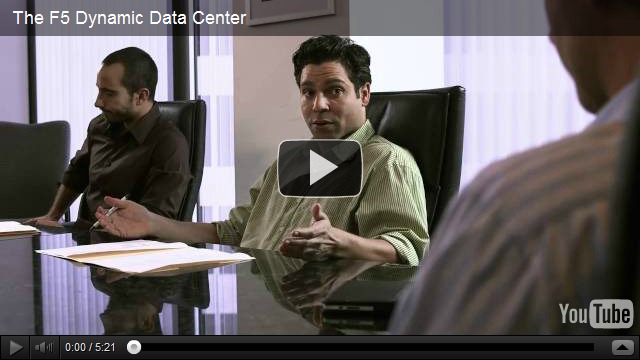
This
video sets the stage for IT having to manage multiple networking
challenges when faced with a natural disaster causing their data center
to shut down. With careful planning, the evolution of the network and
application delivery allows the single point of control to automate,
provision and secure their virtual and cloud environments.
The F5 Dynamic Data Center
ps
Resources:
- 32nd Annual Telly Awards - 2011 Silver Winners
- Telly Awards
- F5 Security Vignette: Proactive Security
- F5 Security Vignette: DNSSEC Wrapping
- F5 Security Vignette: Hacktivism Attack
- F5 Security Vignette: SSL Renegotiation
- F5 Security Vignette: Credit Card iRule
- F5 Security Vignette: Apache HTTP RANGE Vulnerability
- F5 Security Vignette: iHealth
- Security is our Job
- F5 YouTube Feed
Technorati Tags: F5, F5 News, dynamic data center, security, performance, availability, video, Telly Award, youtube
| Connect with Peter: | Connect with F5: |
![o_linkedin[1]](https://lh3.googleusercontent.com/blogger_img_proxy/AEn0k_tIr3b9wRQqqBv611ZSXUKLeac5xXcMoycWN0Kh2BD-DcqgC1j6kZZct8xO-6kXFjGBQdrwnxIkB8dxui8gk4S-x2Dwm1wpSUascAt63H5WbHn1pSJyCbXgItVmO43DfXow1Irqojw3aA3FLrCAJ-jPHtdpt4RI_rVLr5MOcXe6JWaWXiph=s0-d "o_linkedin[1]") ![o_facebook[1]](https://lh3.googleusercontent.com/blogger_img_proxy/AEn0k_visNI-ISlU4A3kE-zzDErKwcAwfS-6jal6W9ZFI-r45QNzeBJiaMJczrTuQDj2j-pyz8NTxx7QLgbzsCCqKCsJ7HZCqqBYRxkluQ_2pLTzsMmQ502oSEw2hylIsxqkfJf1w1pd7-C_6cItkRwlZKKthiLpZgTkLy4y61LnKaZfPgLd-mw=s0-d "o_facebook[1]") ![o_twitter[1]](https://lh3.googleusercontent.com/blogger_img_proxy/AEn0k_uURBNtVQ-_lyNEfnoPKoqoBtK3cEGDfKiXCQ5a7TvMdozVY35sEErmZ_nF5CJPdCLk7-Ff_R9_CmU41Tt_z9RTUafYOm95ljv9l-1KIas-S_rzcprCQDu7JhVhs-ULSpkfl4LY2EaiUwdB_nltmtUVylPW3xtHnJ9bHwE4lLzy4B4yCx0=s0-d "o_twitter[1]") | ![o_slideshare[1]](https://lh3.googleusercontent.com/blogger_img_proxy/AEn0k_tvB6U8uRipqVMamA_U--jQ-mukkK_fw4rUjX3En2tN7wjHErefpvB1llvPDs3S3dZCdRIy7okViAoZ-BMuJesVB2Am-zNvAP8_vsiBOeNoSxPWUB5iLQQmCLamOFigeHeR_TQeUTVI95CQMWAJWBOm2TZpb92V8jUOV-oKo_7cEHracZO9TQM=s0-d "o_slideshare[1]") ![o_youtube[1]](https://lh3.googleusercontent.com/blogger_img_proxy/AEn0k_tfSurMvTwrPzE-HtcwuqNQ_WXQd7fJnJFqU79pKlJrf7N-jnnntKc1XVOYUA3MdtHoXD7biLrzNbZ52t5kN3FXtJwJ4aBSnYGqOUJ8cqU308NXpYAR7YMD46OFxr5bTgNs3yAtwH7y7K2xX7KWi7Ttwj5dcQocSbRQzzlS_SKGcxcj7w=s0-d "o_youtube[1]") |
Subscribe to:
Posts (Atom)

