Showing posts with label business continuity. Show all posts

Monday, July 2, 2012

Cloud vs Cloud

The Battle of the Clouds

Aloha!  Welcome ladies and gentleman to the face off of the decade.  The Battle of the Clouds.  In this corner, the up and comer, the phenom that has changed the way IT works, wearing the light shorts - The Cloud!  And in this corner, your reigning champ, born and bred of Mother Nature with unstoppable power, wearing the dark trunks - Storm Clouds!  

You’ve either read about or lived through the massive storm that hit the Mid-Atlantic coast last week.  And, by the way, if you are going through a loss, damage or worse, I do hope you can recover quickly and wish you the best.   The weather took out power for millions including a Virginia ‘cloud’ datacenter which hosts a number of entertainment and social media sites.  Many folks looking to get thru the candle-lit evenings were without their fix.  While there has been confusion and growing pains over the years as to just what ‘cloud computing’ is, this instance highlights the fact that even The Cloud is still housed in a data center, with four walls, with power pulls, air conditioning, generators and many of the features we’ve become familiar with ever since the early days of the dot com boom (and bubble).   They are physical structures, like our homes, that are susceptible to natural disasters among other things.  Data centers have outages all the time but a single traditional data center outage might not get attention since it may only involve a couple companies – when a ‘cloud’ data center crashes, it could impact many companies and like last week, it grabbed headlines.

Business continuity and disaster recovery are one of the main concerns for organizations since they rely on their system’s information to run their operations.  Many companies use multiple data centers for DR and most cloud providers offer multiple cloud ‘locations’ as a service to protect against the occasional failure.   But it is still a data center and most IT professionals have come to accept that a data center will have an outage – it’s just a question of how long and what impact or risk is introduced.  In addition, you need the technology in place to be able to swing users to other resources when a outage occurs.   A good number of companies don’t have a disaster recovery plan however, especially when backing up their virtual infrastructure in multiple locations.  This can be understandable for a smaller start ups if backing up data means doubling their infrastructure (storage) costs but can be double disastrous for a large multi-national corporation. 

While most of the data center services have been restored and the various organizations are sifting through the ‘what went wrong’ documents, it is an important lesson in redundancy….or the risk of lack of.  It might be an acceptable risk and a conscious decision since redundancy comes with a cost – dollars and complexity.  A good read about this situation is Ben Coe’s My Friday Night With AWS.

The Cloud has been promoting (and proven to some extent) it’s resilience, DR capabilities and it’s ability to technologically recover quickly yet Storm Clouds have proven time and again, that it’s power is unmatched…especially when you need power to turn on a data center. 

ps

Resources

Technorati Tags: F5, cloud research, integration, cloud computing, Pete Silva, security, business, technology, cloud, aws,disaster recovery, web,internet

Connect with Peter: Connect with F5:
o_linkedin[1] o_rss[1] o_facebook[1] o_twitter[1]   o_facebook[1] o_twitter[1] o_slideshare[1] o_youtube[1]

Wednesday, February 22, 2012

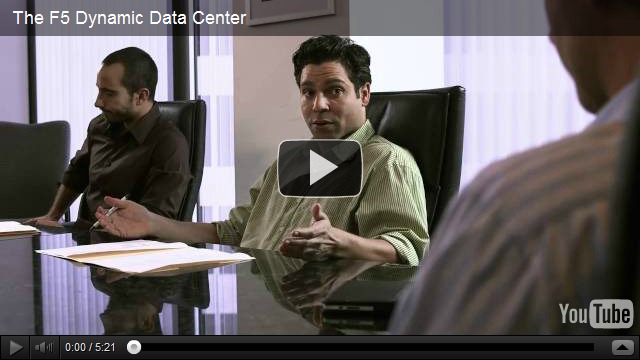
2011 Telly Award Winner - The F5 Dynamic Data Center

Founded in 1978 to honor excellence in local, regional, cable TV commercials along with non-broadcast video and TV programs, The Telly Awards is the premier award honoring the finest film and video productions, groundbreaking web commercials, videos and films, and outstanding local, regional, and cable TV commercials and programs.  Produced in conjunction with Connect Marketing, we are proud to share that F5’s video, The Dynamic Data Center, is a Silver Winner for the 32nd Annual Telly Awards.
 
This video sets the stage for IT having to manage multiple networking challenges when faced with a natural disaster causing their data center to shut down. With careful planning, the evolution of the network and application delivery allows the single point of control to automate, provision and secure their virtual and cloud environments.
The F5 Dynamic Data Center

ps

Resources:

Connect with Peter: Connect with F5:
o_linkedin[1] o_rss[1] o_facebook[1] o_twitter[1]   o_facebook[1] o_twitter[1] o_slideshare[1] o_youtube[1]

Tuesday, September 21, 2010

Thursday, September 16, 2010

Oracle RMAN Replication with F5's BIG-IP WOM

In this side by side demo, you will see an Oracle database duplicated using the RMAN process, both with and without Wan acceleration from F5. How to accelerate Oracle Recovery Manager database duplication using F5's Wan Optimization technology.

ps

Technorati Tags: F5, infrastructure 2.0, integration, business, education, technology, application delivery, orcl, oracle, peoplesoft, context-aware, infrastructure 2.0, automation, web, internet, blog

twitter: @psilvas

Digg This

Wednesday, July 7, 2010

CloudFucius Dials Up the Cloud

Konfuzius-1770 According to IDC, the worldwide mobile worker population is set to increase from 919.4 million in 2008, accounting for 29% of the worldwide workforce, to 1.19 billion in 2013, accounting for 34.9% of the workforce.  The United States has the highest percentage of mobile workers in its workforce, with 72.2% of the workforce mobile in 2008.  This will grow to 75.5% by the end of the forecast period to 119.7 million mobile workers.  The U.S. will remain the most highly concentrated market for mobile workers with three-quarters of the workforce being mobile by 2013 and Asia/Pacific (excluding Japan) represents the largest total number of mobile workers throughout the forecast, with 546.4 million mobile workers in 2008 and 734.5 million in 2013.  This means more workers will be using mobile devices, not being tied to an office cube and will need to have access back to the corporate network or applications hosted in the Cloud.

Enterprises and management are faced with a potential contradictory business situation.  The level of employee collaboration is on the rise; yet at the same time, the locations and work hours are changing and growing.  Additionally, companies understand the importance of providing access to their critical systems, even during a disaster; and that doesn’t necessarily mean a major tornado, flood, hurricane, earthquake or other natural phenomenon.  What does an enterprise do when it’s so cold and snowy that employees can’t get to the office?  Declare a “snow day” and close their doors?  Certainly not.  What does an employee do when they are sick, injured or their child is home from school?  Depending on the severity, they might be able to work from home.  As for the users, it's not just a bunch of office employees and road warriors accessing shared files; but it’s also consultants, contractors, telecommuters, partners and customers using home computers and mobile devices to get our job done.  Squeezed in the middle are the IT guys facing the demands of both management and users, along with the ever expanding and evolving security requirements.

SSL VPN has become the mainstream technology of choice for remote access and Infonetics reports that the Worldwide SSL VPN gateway revenue increased 13.9% to $116.8M in 4Q09 and will grow 19% to $138.7M by 4Q10.  Traditionally, corporate VPN controllers have been deployed in-house or in the corporate data center since the needed resources were also located there.  Management and control over that VPN has been critical since it’s the gateway to the corporate network along with much of the sensitive info that resides ‘on-the-inside.’  Plus, *most* VPN controllers are full appliances – dedicated/branded hardware with the vendor’s code baked in.  Finally, the advancement of cloud computing has become an enticing choice for IT departments looking to deploy corporate systems and sensitive resources for user and customer access. 

Enter FirePass SSL VPN Virtual Edition.

fpve blue

A couple weeks ago F5 released FirePass v7, improving SSL VPN functionality, scalability, third-party integration, and offering new flexible deployment options including a virtual appliance.   Virtualization as a technology, has reached a point of widespread adoption and many customers have requested the option of running FirePass as a virtual appliance.  Providing a virtual edition of FirePass allows customers to potentially save money by allowing them add SSL VPN functionality to their existing virtual infrastructure.   With FirePass VE, you get better scalability & flexibility due to the ability of being able to spin up and spin down virtual FirePass instances across the globe, in much the same way we talk about the BIG-IP appliances managing virtualized environments around the world.

FirePass Virtual Edition is the full fledged, full featured FirePass code and currently runs on VMware ESX* and ESXi 4.0*.  It’s vMotion enabled and you can cluster for config-sync, load balance VMs and service providers can have multiple VMs running on one system for a hosted VPN service.  FirePass VE provides flexibility, scalability, context, and control particularly for Small & Medium Enterprises whose budgets might still be tight but need a remote access solution.  It’s also a perfect solution for Enterprises who need a remote access business continuity solution.

*Asterisk alert: If you are like me, and see a little * after something, I immediately drop to the bottom fine print to find the catch.  FirePass VE is sold & supported just like FirePass hardware and is fully supported on the VMware products listed above.  VMware also has a link off their website about the FirePass VE/VMware interoperability.  As with any piece of software, there are minimum hardware and configuration requirements along with recommended VM provisioning but actual performance may vary depending on the target system.  The FirePass v7 VE release notes (logon may be required) does provide the VMware system minimum characteristics.  Just want to properly set expectations, especially with that pesky asterisk.  :-)

And one from Confucius: A man who has committed a mistake and doesn't correct it, is committing another mistake. 

ps


The CloudFucius Series: Intro, 1, 2, 3, 4, 5, 6, 7, 8, 9, 10, 11


Technorati Tags: F5, infrastructure 2.0, integration, cloud connect, Pete Silva, security, business, education, technology, application delivery, cloud, context-aware, infrastructure 2.0, automation, web, internet, blog, vmware, ssl vpn


twitter: @psilvas

Posted via email from psilva's prophecies

Monday, June 21, 2010

Audio White Paper - The Optimized and Accelerated Cloud

As more organizations begin moving applications into the cloud, congestion will become an increasingly critical issue. F5 offers solutions for optimizing and accelerating applications in the cloud, making them fast and available wherever they reside.  Running time: 21:50   Read full white paper here.  

And click here for more F5 Audio.

ps

twitter: @psilvas

Technorati Tags: F5, infrastructure 2.0, integration, cloud connect, Pete Silva, security, business, education, technology, application delivery, intercloud, cloud, context-aware, infrastructure 2.0, automation, web, internet

Posted via web from psilva's prophecies

Sunday, June 20, 2010

Audio Tech Brief: Connecting to the Cloud with F5 BIG-IP Solutions and VMware VMotion

This integrated solution between F5 and VMware enables long distance VMotion for the first time between data centers and clouds. The solution works with your existing network and IT infrastructure; it does not require a re-architecture of your local or remote networks. This seamless solution uses existing technologies from both F5 and VMware to enable transparent live VM migration over long distances, guaranteeing the applications are migrated in a secure and optimized manner and always remain available before, during, and after the VMotion migration. Moving your applications and services transparently between clouds is now possible with F5 and VMware.  Running time:18:02  Read full Tech Brief here.

And click here for more F5 Audio.

ps

twitter: @psilvas

Technorati Tags: F5, infrastructure 2.0, integration, cloud connect, Pete Silva, security, business, education, technology, application delivery, intercloud, cloud, context-aware, infrastructure 2.0, automation, web, internet,

Posted via web from psilva's prophecies

Saturday, June 19, 2010

Audio White Paper – Scaling SIP

Since Session Initiation Protocol (SIP) was originally defined as a signaling protocol for multimedia sessions, SIP has grown beyond its targeted use as an IP-based telephony messaging medium to conferencing and instant messaging.   A service provider infrastructure focused on supporting IP-based telephony services is necessarily more complex than simple, web-based services. This makes ensuring reliable, scalable services more difficult.  This paper addresses the challenges and solutions when providing high-availability and scalability for SIP services.  By choosing the right high-availability solution for SIP environments, organizations can ensure reliable services while maintaining the ability to rapidly support new functionality and infrastructure without sacrificing uptime or quality.  Running time: 18:31 Read the full white paper here  And click here for more F5 Audio.

  
Download now or listen on posterous
AudioWP_-_Scaling_SIP.mp3 (12690 KB)


ps

twitter: @psilvas

Technorati Tags: F5, infrastructure 2.0, integration, cloud connect, Pete Silva, security, business, education, technology, application delivery, intercloud, cloud, context-aware, infrastructure 2.0, automation, web, internet

Posted via web from psilva's prophecies

Friday, June 18, 2010

Audio White Paper - BIG-IP Version 10.1: An Integrated Application Delivery Architecture

As an advanced ADC, F5 BIG-IP v10.1 provides sophisticated, integrated, contextual application management on a single platform. This modular architecture enables IT departments to make the most of their application delivery infrastructure, saving capital and operational costs through the lifespan of the application. As data centers continue to grow in complexity and shrink in footprint, integration of services will become a critical component during planning and execution. F5 BIG-IP v10.1 provides the level of integration today’s IT departments need to manage and control application delivery for users and services throughout the data center.  Read full white paper here.  And click here for more F5 Audio.

ps

twitter: @psilvas

Technorati Tags: F5, infrastructure 2.0, integration, Pete Silva, security, business, education, technology, application delivery, cloud, context-aware, infrastructure 2.0, automation, web, internet

Posted via web from psilva's prophecies

Wednesday, June 16, 2010

Audio White Paper - Disaster Recovery - Not Just Planning For The Worst

This paper describes how businesses can use F5 Networks’® BIG‑IP® Global Traffic Manager™ to leverage all the benefits of their secondary site in an active-active configuration to holistically manage their applications across multiple sites. This paper also describes how you can use BIG-IP® Link Controller™ to maintain ISP link connectivity and WANJet™ to accelerate site-to-site data replication across the WAN.  Read full White paper here.   And click here for more F5 Audio.

ps

twitter: @psilvas

Technorati Tags: F5, infrastructure 2.0, integration, Pete Silva, security, business, education, technology, application delivery, cloud, context-aware, infrastructure 2.0, automation, web, internet

Posted via web from psilva's prophecies