Showing posts with label identity theft. Show all posts

Thursday, March 4, 2021

Credential Stuffing: Why It’s Here to Stay

Over the last few years, #F5​ security researchers have identified credential​ stuffing​ as one of today’s foremost threats. The value of stolen credentials has created a vicious circle: organizations suffer network intrusions in pursuit of credentials, and credential stuffing in pursuit of profits. Understanding both the supply and demand sides of the market for stolen credentials is, therefore, key to understanding the risk that cybercriminals pose to organizations today. With 5 years of data, it is definitive: credential spills are here to stay. So, let’s start the clock for some harrowing data from the 2021 Credential Stuffing Report.

Get your copy: https://www.f5.com/labs/articles/threat-intelligence/2021-credential-stuffing-report


Tuesday, November 17, 2015

Identity Theft: Not So Scary Anymore?

This article originally appeared on F5.com on 10.20.15.

With Halloween in our rearview mirror and the holiday shopping season upon us, a couple surveys are out examining our fears and in particular, our concerns about identity theft. Apparently, ID theft is not so scary anymore - like entering a haunted house for the hair-raising screams but walking out with nervous giggles.

Over at Bankrate.com, only 54% of surveyed tricksters says they are somewhat or very frightened of ID theft. That's down 80% from those who expressed the same level of concern back in 2008. Almost half, 43%, claim they have little or no fear, trouncing the 19% who were brave in 2008. This is all while the overall victim count remains at similar levels - 12.5 million in 2008 verses 12.7 million in 2014 according to Javelin Strategy & Research. As far as knowing someone who has been hit, 46% say they or a friend has been a victim compared to 34% in 2008.

They chalk it up to people being desensitized to breaches due to the almost weekly confessions of data intrusions. The general feeling is that if large retailers, health care providers and credit agencies can't keep my data safe, how can I. More of those same folks however are also following some good advice of shredding sensitive documents (72%), checking their credit report regularly (56%), avoiding insecure WiFi (54%) and almost 20% have frozen their credit files. These are all good ways to help you worry less.

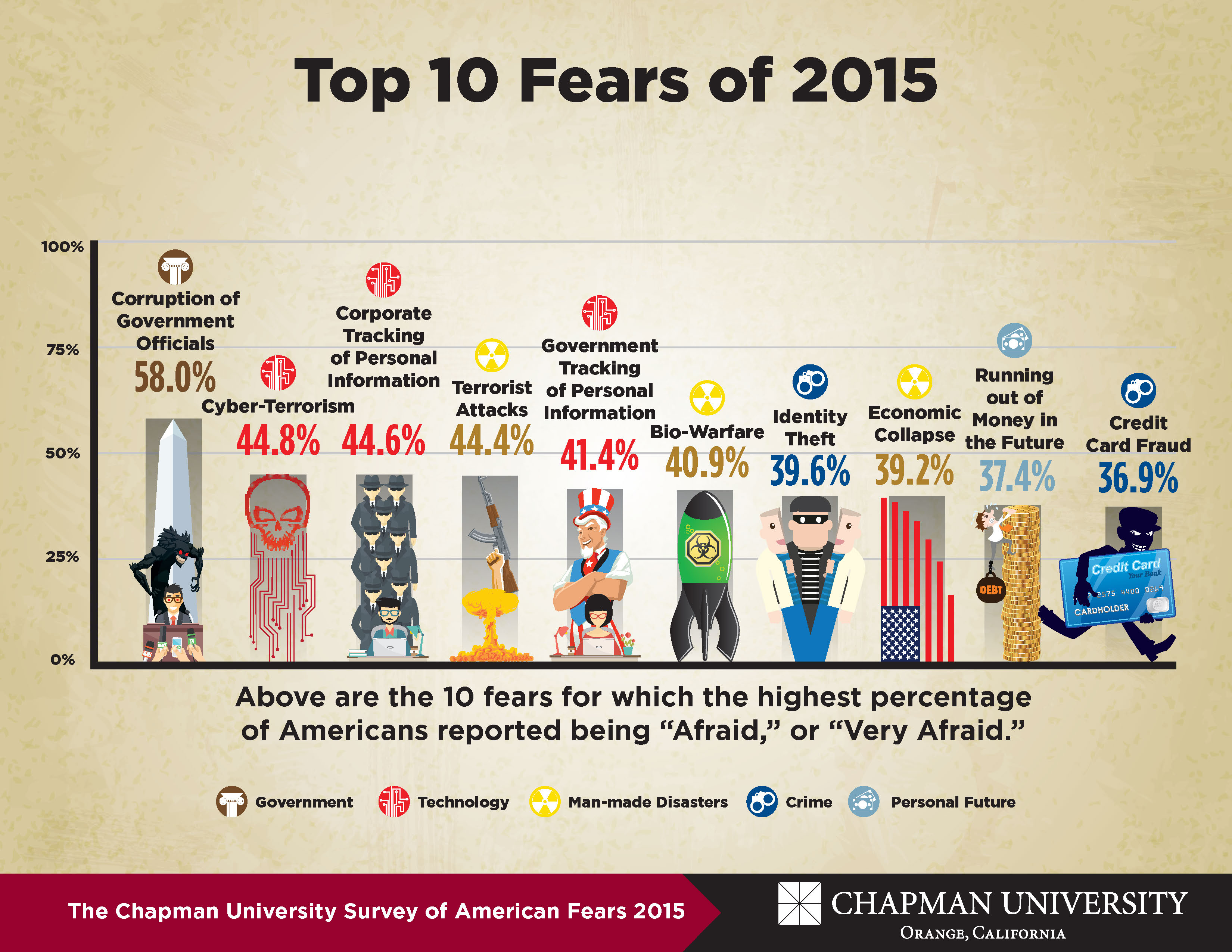
And Chapman University published their Survey of American Fears, Wave 2 (2015) examining the fears of average Americans. The domains of fear include areas like crime, natural and man made disasters, personal anxieties, environment, technology and others. Along with the corruption, terrorism and warfare, identity theft comes in at 39.6% and credit card fraud sits at 36.9%. Both in the Top 10.


So, while ID theft is still one of our top fears, by the time you get to Nightmare on Identity Street 4, Freddy isn't so freighting and you have some tools to deal with him.

Besides, your insecure connected kettles could be exposing your WiFi passwords without your knowledge. Now that's scary!

ps

Related
Connect with Peter: Connect with F5:
o_linkedin[1] o_rss[1] o_twitter[1]   o_facebook[1] o_twitter[1] o_slideshare[1] o_youtube[1]

Tuesday, July 22, 2014

Fear and Loathing ID Theft

Do you avoid stores that have had a credit card breach?

You are not alone. About 52% of people avoid merchants who have had a data breach according to a recent Lowcards survey. They surveyed over 400 random consumers to better understand the impact of identity theft on consumer behavior. 17% said they or a family member was a victim of identity theft over the last year with half the cases being credit card theft. 94% said they are more concerned or equally concerned about ID theft. They estimate that there were 13.5 million cases of credit card identity theft in the United States over the last 12 months.

These concerns are also changing the way some people shop.

Over half (56%) are taking extra measures to protect themselves from identity theft. Some of these behaviors include using a debit card less (28%), using cash more (25%), ordering online less (26%) and checking their credit report more (38%). These are all reasonable responses to the ever challenging game of protecting your identity and is important since 89% of security breaches and data loss incidents could have been prevented last year, according to the Online Trust Alliance's 2014 Data and Breach Protection Readiness Guide.

The game is changing however, and mobile is the new stadium. Let's check that scoreboard.

Most of the security reports released thus far in 2014, like the Cisco 2014 Annual Security Report and the Kaspersky Security Bulletin 2013 show that threats to mobile devices are increasing. We are using them more and using them for sensitive activities like shopping, banking and storing personally identifiable information. It is no wonder that the thieves are targeting mobile and getting very good at it. Kaspersky's report talks about the rise of mobile botnets and the effectiveness since we never shut off our phones. They are always ready to accept new tasks either from us or, a foreign remotely controlled server with SMS trojans leading the pack. Mobile trojans can even check on the victim's bank balance to ensure the heist is profitable and some will even infect your PC when you USB the phone to it.

stat_ksb_2013_04

Distribution of exploits in cyber-attacks by type of attacked application

I guess the good news is that people are becoming much more aware of the overall risks surrounding identity theft and breaches but will the convenience and availability of mobile put us right back in that dark alley? Mobile threats are starting to reach PC proportions with online banking being a major target and many of the potential infections are delivered via SMS messages. Sound familiar?

Maybe we can simply cut and replace 'PC' with 'Mobile' on all those decade old warnings of:

Watch what you click!

ps

Related


Connect with Peter: Connect with F5:
o_linkedin[1] o_rss[1] o_twitter[1]   o_facebook[1] o_twitter[1] o_slideshare[1] o_youtube[1]

Wednesday, May 21, 2014

Moving Target

bekinsblur I moved recently. Not too far away nor to a different state, just the other side of town. It is simultaneously exhilarating and exhausting. Most people in the U.S. moving during the summer. Kids are out of school, the weather is mostly nice, friends might be available to help and you are settled in for the holidays. And while you are worrying about packing, movers, mail and all the other check lists, your identity is ripe for the picking.

The increased risk of identity theft during a move is because personally identifiable information is being shuffled around from one home to the next. At the same time, buyers and renters are preoccupied with the move and can forget to protect their sensitive documents. You may lock up or personally carry your jewelry, checkbook and other 'valuables' but your personal information might be unprotected and targeted during a move.

If you are moving this summer like I just did, there are a few things you can do to minimize the risk. While most moving sites have 'Change of Address' as their top protection mechanisms (which we'll get to), I feel that shredding old bills, receipts and financial info is critical. First, you might not want to drag all that old paperwork with you, especially if you are paying by the pound but more importantly, shredding important documents can prevent thieves from finding any information in your trash. Old-skool dumpster diving is still a viable method to steal personal information. You also might not want the movers themselves to have access to those documents, particularly if you are having them help pack. I was fortunate to find reputable movers but mover fraud is becoming more commonplace in the U.S.

Mail call! What? Oh yea, Change of Address. Seems like a no brainer, filling out a postal change of address but it is also important. Make the change with all the companies, financial institutions, magazines, and other organizations that regularly send you mail. Identity theft is often carried out by stealing mail. The folks who move into your old house might not steal your identity, but they will most likely throw away mail that isn’t theirs, and they won’t necessarily take the care to shred it as you would. If your mail continues to be delivered to your old address, it might be left on the doorstep or in an unlocked mailbox, making it very easy for anyone to walk away with it.

Lock down your electronics. Many households have multiple computers now including tablets, mobile phones and other 'things' storing sensitive information. These are a treasure trove. You can carry/pack yourselves and make sure they are always in your possession or password protect and place in a slightly unmarked box. Maybe label it as 'dog food' and the crook, movers or otherwise, just might pass it over. If you plan on donating or recycling your old computer(s), make sure you totally erase the hard drive since criminals can easily retrieve those files and sue them for no good. Slightly related to this, I recently bought a refurbished Blu-ray player with various streaming services. I wanted to replace the one we broke with the exact same one but they stopped making that model. When it arrived, I went in to configure our Netflix account. So I clicked the Netflix icon and it loaded fine. Wait a minute, that's not my Instant Que. Whoever had the unit prior to me, still had their Netflix saved and I could see all their viewing habits. Old episodes of Leave it to Beaver and Attack of the 50 Foot Cheerleader.

And keep an eye out for yourself before, during and after. Check credit monitoring if you have it; your credit report a few months later for anything suspicious; that all your mail is arriving intact; that all your household items are accounted for; and we often leave cars, garages, and other entrances wide open when moving so keep an eye there, if the location warrants.

Physical items can be used to create digital identities and while we may read about ID theft topics when computer breaches are reported, the physical realm is still ripe with fraudsters. Everything is game nowadays but you can take physical and digital action to stay safe when you are finally home sweet home.

ps

Resources:


Connect with Peter: Connect with F5:
o_linkedin[1] o_rss[1] o_twitter[1]   o_facebook[1] o_twitter[1] o_slideshare[1] o_youtube[1]

Wednesday, May 14, 2014

Uncle DDoS'd, Talking TVs and a Hug

Information security is one of those areas where a lot is always happening. From breaches to vulnerabilities to scams to anything else that's designed to store, protect or even attack and pilfer our sensitive information, information security encompasses a lot of things. A Three Ring Circus, Three Little Pigs, The Three Stooges and when three different stories grab my attention, well I just gotta share.

SCMagazine.com had an interesting story yesterday talking about how two servers designed to prevent DDoS attacks were, themselves, used in a DDoS attack. Incapsula reported that it had to fend off a sizable DDoS attack that was launched using high-capacity servers hijacked from a DDoS protection services provider. The attack itself was against an online gaming site and the attackers actually hijacked and commandeered two high capacity servers from a DDoS protection service provider to spearhead the attack. The service provider was so focused on incoming traffic, they had to be notified to take a look at the massive outgoing traffic being sent. While the DDoS protection market has grown with many outsourcing solutions, it is still a shared service. Remember the old tiered-hosting-separated-by-a-partition days? Even if you are not the target, you still might be caught up in it if your neighbor is.

Next up is security experts at NCC Group said SmartTVs with built-in microphones and storage can be turned into bugging devices by malware and used to record conversations. Not to mention remotely turning on the TV camera at will. They did need physical access to the TV to install the malware but as more TV apps get developed, it is conceivable that a malicious app could be downloaded to the TV for the same purpose. They demonstrated how they could capture 30 seconds of buffered mic audio but could have also manipulated more to use internal storage and send the audio files to an awaiting server. NCC engineers wanted to highlight the security shortcomings on the home front of the Internet of Things. Start to get used to no privacy in the privacy of your home.

And last but certainly not least, Thieves steal ID and credit card data with a hug. OK, I'm Hawaiian and we are a bunch of huggers so this is interesting. Apparently a Georgia woman was approached at a gas station by another woman begging for some money so she could put gas in her car. The kind, generous woman gave the crooked lady $20. With a full Oscar nominated performance, the crooked lady wept with joy and wanted to thank the generous one with a hug. Embrace ensued. So touched by the gesture, the man with the crooked lady got out of the car and also wanted to physically thank the Samaritan. The next morning she realized why they wanted to hug her when she discovered that $3000 was gone from her bank account. $2400 from a grocery store and another $200 plus from ATMs. The thieves got close so they could scan her for RFID enabled cards. She had her credit cards in her front pocket and was scanned during the not so loving embrace. Well that sucks. The cool thing is that the woman is not jaded and will continue to help others. Nice.

And to those I know: If we typically hug when we see each other, I promise won't be scanning your pockets.

ps

Related


Connect with Peter: Connect with F5:
o_linkedin[1] o_rss[1] o_twitter[1]   o_facebook[1] o_twitter[1] o_slideshare[1] o_youtube[1]

Wednesday, May 7, 2014

The Reach of a Breach

It comes as no surprise that the CEO of Target has resigned in the wake of their massive data breach. The 2nd executive, if I remember correctly, to resign due to the mishap. Data breaches are costly according to the most recent Ponemon 2014 Cost of Data Breach Study: United States and the main reason for the steep increase in costs is 'the loss of customers following the data breach due to additional expenses required to preserve the organization's brand and reputation.' The cost of each lost or stolen record, on average, increased from $188 to $201 per record from 2012 to 2013 - a 9% increase.

But that's not all, In 2013, there appeared to be 'an abnormal churn rate' of 15% of customers abandoning companies, especially those in financial services, hit by a breach says Ponemon. I'm always curious about that. I usually avoid stores that have been recently compromised wondering if something is lingering yet think, they gotta be on high alert, especially with law enforcement involved. Maybe it's as safe as it ever will be.

A recent Courion survey of IT security executives showed that 78% of respondents say they're anxious about the possibility of a data breach at their organization. If there were a massive security breach at these companies, 58.8% said 'protecting the privacy of our customers' would be top priority and 62.7% would lament about 'negative publicity affecting the company brand' due to the breach. Maybe that's the problem. They're more worried about their image than they are of protecting our info. It's the 58.8% you want to shop at.

Reaching for more, Symantec’s Internet Security Threat Report (ISTR), Volume 19, shows a big change in cybercriminal habits, revealing the bad guys are plotting for months before pulling off the huge heists – instead of popping quick hits with smaller bounty. One big is worth fifty small. In 2013, there was a 62% uptick in the number of data breaches exposing more than 552 million identities. That's about 10% of the planet's population, give-or-take.

And finally, there have been a few companies that have gone out of business due to a leakage but a few months ago a data breach also closed some Seattle area Catholic schools. According to the Seattle Archdiocese, at least three Roman Catholic parishes and the Archdiocese’s chancery offices had been targeted by a tax-fraud scheme. In order to allow those who were victims time to contact the appropriate institutions during school hours, they cancelled classes. How's that for reach.

ps

Related:


Connect with Peter: Connect with F5:
o_linkedin[1] o_rss[1] o_twitter[1]   o_facebook[1] o_twitter[1] o_slideshare[1] o_youtube[1]

Wednesday, March 26, 2014

Malware costs $491 Billion in Perspective

A recent joint study from IDC and the National University of Singapore (NUS) predicts that companies around the globe will spend around $491 billion in 2014 for fixes and recovery from data breaches and malware. The sponsor, Microsoft, also noted that pirated software tweaked with intent is a common method of getting inside. Consumers will likely spend $25 billion as a result of those security threats. $491 billion is a lot of change and in the spirit of Mobile Threats Rise 261% in Perspective, I wanted to know what else costs $491 billion.

Apparently, quite a few things!

U.S. motorists may spend a record $491 billion for gasoline this year. Expensive oil and increased exports have kept our fuel prices high this year. We are still under the 2008 average gas price record but we will still spend more due to gas going up sooner in the year and staying high longer. I know I've seen $4.11 here in California where the average is $3.94. While the winter blend production does bring some relief, don't expect major drops due to higher global demand along with the various feuds in the world.

Back in 2005, the US House of Representatives passed a $491 billion defense bill. This was when we were still in Iraq and the only reason I find this interesting is that the cyber-war can now cost as much as real wars. Not really apple to apples admittedly, but I often talk about how our digital worlds are colliding integrating with our physical lives. Either way, the costs can be very real.

Now at the 3 year mark of the Fukushima meltdown, property damage so far has been assessed at approximately US$200 billion but some estimates show that the total burden will be $491 billion. While one could never put a price on the 19,000 people lost from the earthquake and tsunami, it is kinda spooky that breaches and malware are on par with nuclear disasters.

According to the Global Business Travel Association (GBTA) Foundation business travel was responsible for about 3% of U.S. GDP in 2012 or $491 billion. Essentially, every dollar of business travel spending generated about $1.28 in GDP. Of the $491 billion total, $208 billion accrued directly to businesses that served travelers or meeting attendees.

In 2011 the European chemical industry contributed to 20.9% of the world’s chemical sales valued at €2353 billion, generating € 491 billion of revenues and employing 1.16 million people.

In 2012-13, India's total imports was $491 billion according to their Finance Minister.

And finally, the Earth is 491 billion feet from sun, give or take.

The malware market is on par with the likes of defense budgets, nuclear disasters, overall energy consumption and an entire country's import bill. It is often hard to quantify such large dollar amounts but when compared to the other $491 billion items, you can get a real sense of the magnitude.

ps


Connect with Peter: Connect with F5:
o_linkedin[1] o_rss[1] o_twitter[1]   o_facebook[1] o_twitter[1] o_slideshare[1] o_youtube[1]

Wednesday, March 5, 2014

So Where Do We Go From Here?

If you are who you say you are.

I've been travelling the last few weeks shooting some videos for VMware PEX and RSA. When that happens, my browser tabs get crowded with the various stories I'm interested in but will read later. This time they all seemed to hover around Identity Theft. When I got home, in my awaiting physical mail was a letter from Target. I also returned something to a national hardware store and the cashier tried to crumple my credit-card-info-having receipt into a trash can. Kismet.

Let's take a look...

The FTC recently announced that Identity Theft is the #1 complaint in 2013, for the 14th consecutive year. Is that a record? While down slightly from 2012, it still accounted for 14% of the 2 million overall complaints. This is down from 18% in 2012. Florida, followed by Georgia and California were the worst hit states for ID theft. The IRS has also named Identity Theft as their #1 Dirty Dozen Tax scam for 2014.

Speaking of California, 7.5 million of the over 110 million breached Target accounts were Californians. California is one of the few states that require disclosure when more than 500 accounts are compromised. The first year California required reports, 2012, there were 131 breaches reported...in 2013 that rose to 170. The other interesting thing about California breaches is that many target smaller companies. In 2012, half of the reported breaches came from companies with fewer than 2500 employees and almost a third were businesses with less than 250 employees. Being small and relatively unknown is no shield.

Also in Southern California, the Feds busted a couple guys running a Tijuana-based identity theft ring. These dudes broke into a U.S. based mortgage broker's servers and siphoned off mortgage applications which included most of the borrower's personal info: name, birthday, SSN, DL number, tax info, the works. They then used that info to open credit lines and, with the info they had, were able to change access to the people's brokerage accounts. From there, transferring money to other accounts was a snap. From Dec 2012 thru June 2013 they stole personal data on 4200 individuals.

Javelin Strategy and Research released their annual 2014 Identity Fraud Study stating that in 2013, a new instance of identity fraud occurred every 2 seconds. 1 Mississippi, 2 Mississippi. Another. There was 13.1 million identity fraud victims on 2013. While the people number is going up, the actual money stolen, according to Javelin, in going down. They estimated that the total cost of identity fraud in 2013 to be around $18 billion, more than $3 billion less than 2012. 2004 holds the record at $48 billion. Attackers are now focusing on opening new accounts rather than piggy backing existing credit cards. Account take-over's, particularly for utilities and mobile phones are the new free-bees. Most of the stolen info appears to be from corporate breaches and about 1/3 of those who receive a breach letter actually becomes a theft victim. Your debit card also seems more valuable than your social security number. 46% of consumers with breached debit cards became victims verses only 16% of breached SSNs.

And in an interesting twist, the top complaint against debt collectors is mistaken identity. Trying to collect a debt from the wrong person was by far, the most common complaint to the Consumer Financial Protection Bureau (CFPB). I know this all too well since over the last 3+ years, we've been getting debt collection calls looking for a certain person. We tell them that we've had our phone number for years and stop calling. Few months go by, the debt gets sold to another collector and we get calls again. It got so bad that this person's own mother called to tell her son that the dad was in the hospital and probably wouldn't make it. About 2 weeks later we got a call from another family member looking to talk about the father's death. This guy was running from debt so much so, that his own mother couldn't get a hold of him when dad was on his death bed. Now that's bad.

So where do we go from here? Will we all need that personal chip installed on our left earlobe to verify identity? The payment terminal says, 'Please listen for verification.' Riff-raff will then be all like, 'Oh, listen to this cool song,' as they plug the bud into your ear only to suck the data off your PID chip. You didn't hear? That's our IPv6 Personal Identity Chip inserted into every newborn starting in 2025.

Oh, it will happen.

ps

Related:


Connect with Peter: Connect with F5:
o_linkedin[1] o_rss[1] o_twitter[1]   o_facebook[1] o_twitter[1] o_slideshare[1] o_youtube[1]