#F5Labs 2020 Phishing and Fraud Report. #Phishing remains a popular method of stealing credentials, committing fraud, and distributing malware. In its crudest forms it might appear to be juvenile; but it’s often part of a well-orchestrated, multi-faceted, and sustained attack campaign by organized crime groups. Get all the details of Phishing & Fraud trends for 2020: https://www.f5.com/labs/articles/threat-intelligence/2020-phishing-and-fraud-report
Showing posts with label fraud. Show all posts
Showing posts with label fraud. Show all posts
Saturday, December 26, 2020


Saturday, December 14, 2019
90 Seconds of Security: Phishing Trends for 2019
Phishing has become the number one attack vector for good reason - it
requires a low amount of effort for a very high reward.
F5 Labs (f5labs.com) released their 2019 Phishing and Fraud Report showing that there's no slowing down in the amount or number of phishing attacks. In fact, we expect phishing to occur year-round, not just around the holidays. Download the full report at: https://www.f5.com/labs/articles/threat-intelligence/2019-phishing-and-fraud-report
F5 Labs (f5labs.com) released their 2019 Phishing and Fraud Report showing that there's no slowing down in the amount or number of phishing attacks. In fact, we expect phishing to occur year-round, not just around the holidays. Download the full report at: https://www.f5.com/labs/articles/threat-intelligence/2019-phishing-and-fraud-report
Tuesday, March 26, 2019
How Malware Evades Detection
Malware loves encryption since it can sneak
around undetected. F5Labs 2018 Phishing & Fraud Report explains how malware
tricks users and evades detection.
Let's light up how evasion happens & get your F5 Labs 2018 Phishing & Fraud Report today.
Let's light up how evasion happens & get your F5 Labs 2018 Phishing & Fraud Report today.
Thursday, December 13, 2018
F5 Labs 2018 Phishing & Fraud Report
The F5
Labs 2018 Phishing & Fraud Report is out!
In this report, the F5 Labs team specifically investigated the rise of phishing and fraud during the 'holiday shopping season,' beginning in October and continuing through January. Fraud and phishing attempts increase 50% right now, from October to January and phishing was the root cause of 48% of the data breaches that F5Labs investigated. It's important to check out the report because it explains how phishing works, how to defend yourself against phishing attacks and the importance of training employees to recognize malicious emails.
Some of the crazy stats they found include 93% of phishing domains offered a secure (https) version of the site to appear more legitimate and 68% of malware sites used encryption certificates (https), meaning 68% of Command & Control servers use port 443. The crooks are going through the trouble of getting SSL certificates for their fake, but real looking sites.
Take a look at some of these. Do any of these web logins look familiar?

How about this one?

Or maybe this one?

If so then you need to check out the 2018 Phishing and Fraud report from F5 Labs because they were all fake. Attackers are getting so good at creating fake websites that impersonate the real thing, most people can’t tell the difference. One thing is for certain, employee click-through rates on phishing emails drop from 33% to 13% with security awareness training:
ps
In this report, the F5 Labs team specifically investigated the rise of phishing and fraud during the 'holiday shopping season,' beginning in October and continuing through January. Fraud and phishing attempts increase 50% right now, from October to January and phishing was the root cause of 48% of the data breaches that F5Labs investigated. It's important to check out the report because it explains how phishing works, how to defend yourself against phishing attacks and the importance of training employees to recognize malicious emails.
Some of the crazy stats they found include 93% of phishing domains offered a secure (https) version of the site to appear more legitimate and 68% of malware sites used encryption certificates (https), meaning 68% of Command & Control servers use port 443. The crooks are going through the trouble of getting SSL certificates for their fake, but real looking sites.
Take a look at some of these. Do any of these web logins look familiar?

How about this one?

Or maybe this one?

If so then you need to check out the 2018 Phishing and Fraud report from F5 Labs because they were all fake. Attackers are getting so good at creating fake websites that impersonate the real thing, most people can’t tell the difference. One thing is for certain, employee click-through rates on phishing emails drop from 33% to 13% with security awareness training:
- 33% — 1-5 training events
- 28% — 6-10 training events
- 13% — 11 or more training events
ps
Tuesday, September 27, 2016
Lock Down Your Login

You’ll need two modules for this, BIG-IP APM and of course, WebSafe Fraud Protection Service. The goal is to protect the laptop from any malware that grabs sensitive login credentials. In this case, the malware would be configured to grab the login page along with the username and password parameter fields. Command and control could also be set to retrieve any credentials from the infected machine at certain intervals, like every 5 minutes.
The first goal would be to encrypt the password. Within your BIG-IP admin GUI, you would navigate to Security>Fraud Protection Service> Anti-Fraud Profiles>URL List. APM’s logon page usually ends with ‘/my.policy’.

Create then click that URL to open the configuration page and enable Application Layer Encryption.

And select the Parameters tab to configure the fields you want to protect. In this case it is password and username.

In the screen grab, you can see ‘Obfuscate’ is selected and to both ‘Encrypt’ and ‘Substitute Value’ for the password field.
Now when the user goes to the page, a bit a JavaScript is injected in the page to protect the specified fields. If you run a httpwatch or wire shark on the page, you’ll see that the values for those parameters are obfuscated. This makes it incredibly difficult for the bad actor to determine the correct value.

And if the malware also grabs the password, since we set that to encrypt, all they get is useless information.

At this point, the BIG-IP will decrypt the password and pass on the traffic to appropriate domain controller for verification. This is a great way to protect your login credentials with BIG-IP. If you’d like to see a demonstration of this, check out F5’s Security Specialist Matthieu Dierick’s demo video. Pretty cool.
ps
Tuesday, November 17, 2015
Identity Theft: Not So Scary Anymore?
This article originally appeared on F5.com on 10.20.15.
With Halloween in our rearview mirror and the holiday shopping season upon us, a couple surveys are out examining our fears and in particular, our concerns about identity theft. Apparently, ID theft is not so scary anymore - like entering a haunted house for the hair-raising screams but walking out with nervous giggles.
Over at Bankrate.com, only 54% of surveyed tricksters says they are somewhat or very frightened of ID theft. That's down 80% from those who expressed the same level of concern back in 2008. Almost half, 43%, claim they have little or no fear, trouncing the 19% who were brave in 2008. This is all while the overall victim count remains at similar levels - 12.5 million in 2008 verses 12.7 million in 2014 according to Javelin Strategy & Research. As far as knowing someone who has been hit, 46% say they or a friend has been a victim compared to 34% in 2008.
They chalk it up to people being desensitized to breaches due to the almost weekly confessions of data intrusions. The general feeling is that if large retailers, health care providers and credit agencies can't keep my data safe, how can I. More of those same folks however are also following some good advice of shredding sensitive documents (72%), checking their credit report regularly (56%), avoiding insecure WiFi (54%) and almost 20% have frozen their credit files. These are all good ways to help you worry less.
And Chapman University published their Survey of American Fears, Wave 2 (2015) examining the fears of average Americans. The domains of fear include areas like crime, natural and man made disasters, personal anxieties, environment, technology and others. Along with the corruption, terrorism and warfare, identity theft comes in at 39.6% and credit card fraud sits at 36.9%. Both in the Top 10.
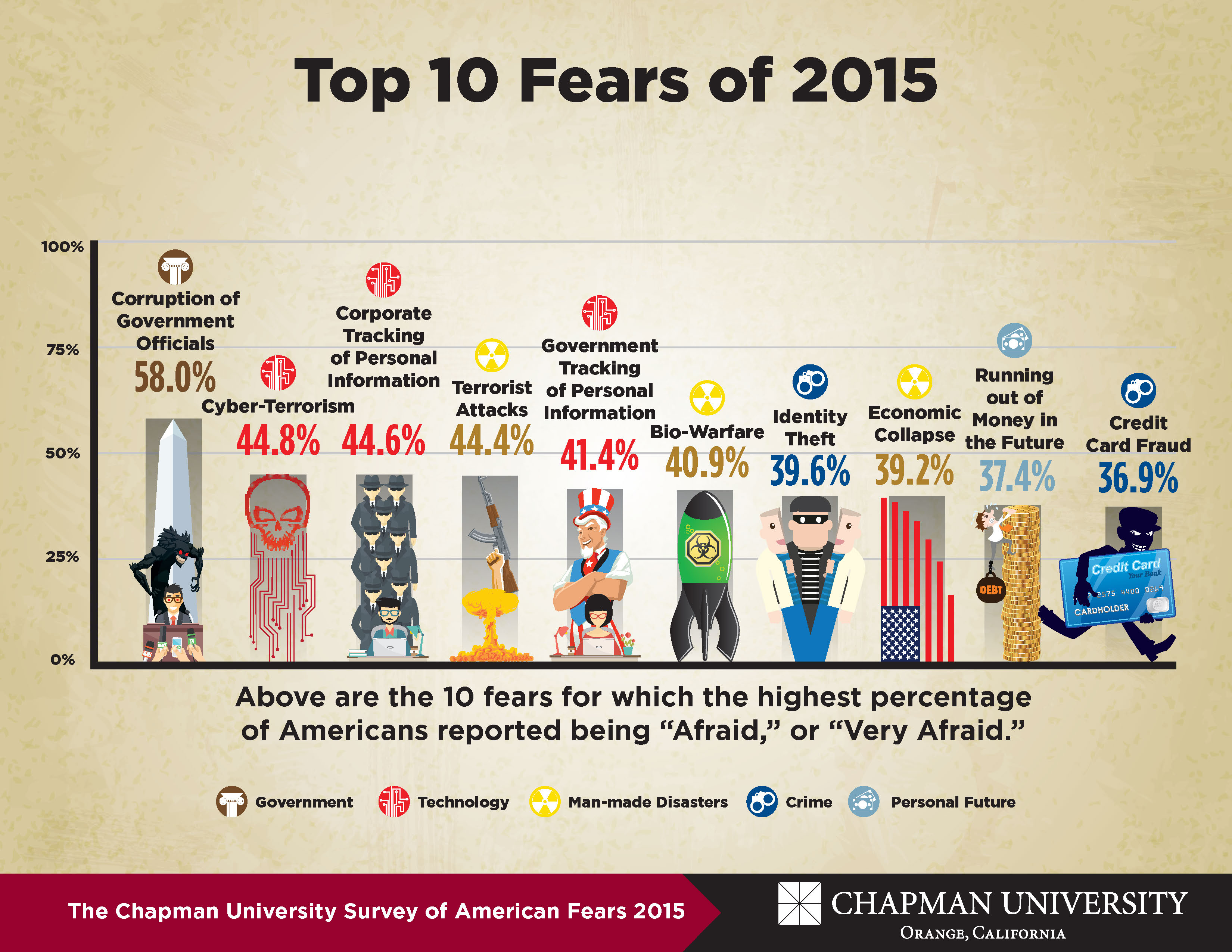
So, while ID theft is still one of our top fears, by the time you get to Nightmare on Identity Street 4, Freddy isn't so freighting and you have some tools to deal with him.
Besides, your insecure connected kettles could be exposing your WiFi passwords without your knowledge. Now that's scary!
ps
Related
With Halloween in our rearview mirror and the holiday shopping season upon us, a couple surveys are out examining our fears and in particular, our concerns about identity theft. Apparently, ID theft is not so scary anymore - like entering a haunted house for the hair-raising screams but walking out with nervous giggles.
Over at Bankrate.com, only 54% of surveyed tricksters says they are somewhat or very frightened of ID theft. That's down 80% from those who expressed the same level of concern back in 2008. Almost half, 43%, claim they have little or no fear, trouncing the 19% who were brave in 2008. This is all while the overall victim count remains at similar levels - 12.5 million in 2008 verses 12.7 million in 2014 according to Javelin Strategy & Research. As far as knowing someone who has been hit, 46% say they or a friend has been a victim compared to 34% in 2008.
They chalk it up to people being desensitized to breaches due to the almost weekly confessions of data intrusions. The general feeling is that if large retailers, health care providers and credit agencies can't keep my data safe, how can I. More of those same folks however are also following some good advice of shredding sensitive documents (72%), checking their credit report regularly (56%), avoiding insecure WiFi (54%) and almost 20% have frozen their credit files. These are all good ways to help you worry less.
And Chapman University published their Survey of American Fears, Wave 2 (2015) examining the fears of average Americans. The domains of fear include areas like crime, natural and man made disasters, personal anxieties, environment, technology and others. Along with the corruption, terrorism and warfare, identity theft comes in at 39.6% and credit card fraud sits at 36.9%. Both in the Top 10.
So, while ID theft is still one of our top fears, by the time you get to Nightmare on Identity Street 4, Freddy isn't so freighting and you have some tools to deal with him.
Besides, your insecure connected kettles could be exposing your WiFi passwords without your knowledge. Now that's scary!
ps
Related
- Survey: More Americans say 'boo' to the ID theft boogeyman
- America’s Top Fears 2015
- Connected kettles boil over, spill Wi-Fi passwords over London
- The Breach of Things
- The Reach of a Breach
- 5 Stages of a Data Breach
| Connect with Peter: | Connect with F5: |
   |    |
Wednesday, March 5, 2014
So Where Do We Go From Here?
If you are who you say you are.
I've been travelling the last few weeks shooting some videos for VMware PEX and RSA. When that happens, my browser tabs get crowded with the various stories I'm interested in but will read later. This time they all seemed to hover around Identity Theft. When I got home, in my awaiting physical mail was a letter from Target. I also returned something to a national hardware store and the cashier tried to crumple my credit-card-info-having receipt into a trash can. Kismet.
Let's take a look...
The FTC recently announced that Identity Theft is the #1 complaint in 2013, for the 14th consecutive year. Is that a record? While down slightly from 2012, it still accounted for 14% of the 2 million overall complaints. This is down from 18% in 2012. Florida, followed by Georgia and California were the worst hit states for ID theft. The IRS has also named Identity Theft as their #1 Dirty Dozen Tax scam for 2014.
Speaking of California, 7.5 million of the over 110 million breached Target accounts were Californians. California is one of the few states that require disclosure when more than 500 accounts are compromised. The first year California required reports, 2012, there were 131 breaches reported...in 2013 that rose to 170. The other interesting thing about California breaches is that many target smaller companies. In 2012, half of the reported breaches came from companies with fewer than 2500 employees and almost a third were businesses with less than 250 employees. Being small and relatively unknown is no shield.
Also in Southern California, the Feds busted a couple guys running a Tijuana-based identity theft ring. These dudes broke into a U.S. based mortgage broker's servers and siphoned off mortgage applications which included most of the borrower's personal info: name, birthday, SSN, DL number, tax info, the works. They then used that info to open credit lines and, with the info they had, were able to change access to the people's brokerage accounts. From there, transferring money to other accounts was a snap. From Dec 2012 thru June 2013 they stole personal data on 4200 individuals.
Javelin Strategy and Research released their annual 2014 Identity Fraud Study stating that in 2013, a new instance of identity fraud occurred every 2 seconds. 1 Mississippi, 2 Mississippi. Another. There was 13.1 million identity fraud victims on 2013. While the people number is going up, the actual money stolen, according to Javelin, in going down. They estimated that the total cost of identity fraud in 2013 to be around $18 billion, more than $3 billion less than 2012. 2004 holds the record at $48 billion. Attackers are now focusing on opening new accounts rather than piggy backing existing credit cards. Account take-over's, particularly for utilities and mobile phones are the new free-bees. Most of the stolen info appears to be from corporate breaches and about 1/3 of those who receive a breach letter actually becomes a theft victim. Your debit card also seems more valuable than your social security number. 46% of consumers with breached debit cards became victims verses only 16% of breached SSNs.
And in an interesting twist, the top complaint against debt collectors is mistaken identity. Trying to collect a debt from the wrong person was by far, the most common complaint to the Consumer Financial Protection Bureau (CFPB). I know this all too well since over the last 3+ years, we've been getting debt collection calls looking for a certain person. We tell them that we've had our phone number for years and stop calling. Few months go by, the debt gets sold to another collector and we get calls again. It got so bad that this person's own mother called to tell her son that the dad was in the hospital and probably wouldn't make it. About 2 weeks later we got a call from another family member looking to talk about the father's death. This guy was running from debt so much so, that his own mother couldn't get a hold of him when dad was on his death bed. Now that's bad.
So where do we go from here? Will we all need that personal chip installed on our left earlobe to verify identity? The payment terminal says, 'Please listen for verification.' Riff-raff will then be all like, 'Oh, listen to this cool song,' as they plug the bud into your ear only to suck the data off your PID chip. You didn't hear? That's our IPv6 Personal Identity Chip inserted into every newborn starting in 2025.
Oh, it will happen.
ps
Related:
- FTC: Identity theft is the plague of the country
- Calif. attorney general focuses on retailers' data theft
- Tijuana-Based ID Theft Conspiracy Busted
- Javelin Study: A New Identity Fraud Victim Every Two Seconds
- The 2013 FireEye Advanced Threat Report!
- Mistaken identity top complaint against debt collectors
- RSA 2014: Anti-Fraud Solution (feat DiMinico)
| Connect with Peter: | Connect with F5: |
| | |
Subscribe to:
Posts (Atom)
