Showing posts with label research. Show all posts

Tuesday, January 26, 2021

How Ransomware Has Evolved to Be Faster, Stealthier, and Strike Harder


Ransomware attacks have reached the boiling point. They’ve gone from nuisance to significant financial burden—as well as a mortal threat to critical infrastructure. Financial damage from ransomware attacks is in the hundreds of millions of dollars for some organizations. And, of course, our F5 Labs threat researchers have something to say about it. So, let’s start the clock to explore How Ransomware Has Evolved to Be Faster, Stealthier, and Strike Harder. 

Full article: https://www.f5.com/labs/articles/threat-intelligence/ransomware-how-it-has-evolved-to-be-faster-stealthier-and-strike-harder

Wednesday, May 7, 2014

The Reach of a Breach

It comes as no surprise that the CEO of Target has resigned in the wake of their massive data breach. The 2nd executive, if I remember correctly, to resign due to the mishap. Data breaches are costly according to the most recent Ponemon 2014 Cost of Data Breach Study: United States and the main reason for the steep increase in costs is 'the loss of customers following the data breach due to additional expenses required to preserve the organization's brand and reputation.' The cost of each lost or stolen record, on average, increased from $188 to $201 per record from 2012 to 2013 - a 9% increase.

But that's not all, In 2013, there appeared to be 'an abnormal churn rate' of 15% of customers abandoning companies, especially those in financial services, hit by a breach says Ponemon. I'm always curious about that. I usually avoid stores that have been recently compromised wondering if something is lingering yet think, they gotta be on high alert, especially with law enforcement involved. Maybe it's as safe as it ever will be.

A recent Courion survey of IT security executives showed that 78% of respondents say they're anxious about the possibility of a data breach at their organization. If there were a massive security breach at these companies, 58.8% said 'protecting the privacy of our customers' would be top priority and 62.7% would lament about 'negative publicity affecting the company brand' due to the breach. Maybe that's the problem. They're more worried about their image than they are of protecting our info. It's the 58.8% you want to shop at.

Reaching for more, Symantec’s Internet Security Threat Report (ISTR), Volume 19, shows a big change in cybercriminal habits, revealing the bad guys are plotting for months before pulling off the huge heists – instead of popping quick hits with smaller bounty. One big is worth fifty small. In 2013, there was a 62% uptick in the number of data breaches exposing more than 552 million identities. That's about 10% of the planet's population, give-or-take.

And finally, there have been a few companies that have gone out of business due to a leakage but a few months ago a data breach also closed some Seattle area Catholic schools. According to the Seattle Archdiocese, at least three Roman Catholic parishes and the Archdiocese’s chancery offices had been targeted by a tax-fraud scheme. In order to allow those who were victims time to contact the appropriate institutions during school hours, they cancelled classes. How's that for reach.

ps

Related:


Connect with Peter: Connect with F5:
o_linkedin[1] o_rss[1] o_twitter[1]   o_facebook[1] o_twitter[1] o_slideshare[1] o_youtube[1]

Tuesday, October 22, 2013

Privacy for a Price

A few weeks ago, I went to my usual haircut place and after the trim at the register I presented my loyalty card.  You know the heavy paper ones that either get stamped or hole-punched for each purchase.  After a certain number of paid visits, you receive a free haircut.  I presented the card, still in the early stages of completion, for validation and the manager said I could convert the partially filled card to their new system.  I just had to enter my email address (and some other info) in the little kiosk thingy.  I declined saying, 'Ah, no thanks, enough people have my email already and don't need yet another daily digest.'  He continued, 'well, we are doing away with the cards and moving all electronic so...'  'That's ok,' I replied, 'I'll pay for that extra/free haircut to keep my name off a mailing list.' 

This event, of course, got me thinking about human nature and how we will often give up some privacy for either convenience or something free.  Imagine a stranger walking up to you and asking for your name, address, email, birthday, income level, favorite color and shopping habits.  Most of us would tell them to 'fill in the blank'-off.  Yet, when a Brand asks for the same info but includes something in return - free birthday dinner, discounted tickets, coupons, personalized service - we typically spill the beans.

Infosys recently conducted a survey which showed that consumers worldwide will certainly share personal information to get better service from their doctors, bank and retailers; yet, they are very sensitive about how they share. Today’s digital consumers are complicated and sometimes suspicious about how institutions use their data, according to the global study of 5,000 digitally savvy consumers.  They also created an infographic based on their findings.

Overall they found:

  • 82 percent want data mining for fraud protection, will even switch banks for more security;
  • 78 percent more likely to buy from retailers with targeted ads, while only 16 percent will share social profile;
  • 56 percent will share personal and family medical history with doctors

...and specific to retail:

  • To know me is to sell to me: Three quarters of consumers worldwide believe retailers currently miss the mark in targeting them with ads on mobile apps, and 72 percent do not feel that online promotions or emails they receive resonate with their personal interests and needs
  • To really know me is to sell me even more: A wide majority of consumers (78 percent) agree that they would be more likely to purchase from a retailer again if they provided offers targeted to their interests, wants or needs, and 71 percent feel similarly if offered incentives based on location
  • Catch-22 for retailers? While in principle shoppers say they want to receive ads or promotions targeted to their interests, just 16 percent will share social media profile information. Lacking these details could make it difficult for retailers to deliver tailored digital offers

Your data is valuable and comes with a price.  While many data miners are looking to capitalize on our unique info, you can always decline.  Yes, it is still probably already gathered up somewhere else; Yes, you will probably miss out on some free or discounted something; Yes, you will probably see annoying pop-up ads on that free mobile app/game and; Yes, you might feel out of the loop. 

But, it was still fun to be in some control over my own info leaks.

ps

Related:


Connect with Peter: Connect with F5:
o_linkedin[1] o_rss[1] o_twitter[1]   o_facebook[1] o_twitter[1] o_slideshare[1] o_youtube[1]

Tuesday, June 25, 2013

BYOD Behavior - Size Does Matter

Not the device's but your behavior.  Harvard Business School researchers wanted to determine if the type of device people use changes how they act around other people.  Does device size affect assertiveness?  Does interacting with a device of a certain size, affect how you behave afterword?  Or, Is Your iPhone turning you into a Wimp?

If you just can't stand the suspense, in a word, Yes.

Many of us are aware that body language can communicate so much more than words.  If you watch (and can understand) people's body language, you can learn much more than just what they are saying.  Are they uncomfortable or are they hiding something.  Are they imagining something or recalling from memory.  You might have even heard of micro-expressions - those little head scrunches, slight eye squint or a tight jaw that sends a message. In addition, by adopting certain postures, body chemistry and behavior can be affected.  For example, standing over someone's desk with arms wide, generally brings more assertiveness than sitting across with arms and legs crossed.  So how about our posture while using a mobile device since we spend an average of 58 minutes per day our smartphones?  Would it then make sense that a larger (arms wide) screen person would be more assertive than someone using a smaller (arms crossed) screen?

Apparently so.

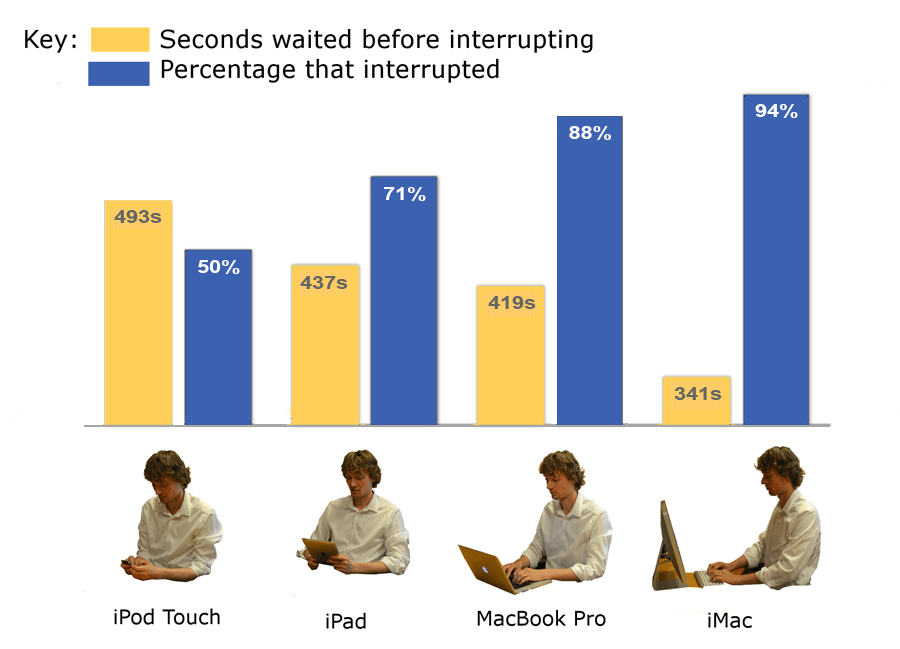
The study, 'iPosture: The Size of Electronic Consumer Devices Affects Our Behavior,' looked at how the body posture inherent in operating everyday gadgets affects not only your body, but also your demeanor.  It showed that working on a relatively large machine (like a desktop computer) causes users to act more assertively than working on a small one (like an iPod).

The researchers asked participants to perform randomly assigned tasks on one of four different sized devices: iPod Touch, iPad, MacBook Pro Laptop or iMac Desktop.  They answered a survey, played a gambling game and a few other tasks and when they were done, the researcher told them, 'I will get some forms ready for you to sign so I can pay you and you can leave. If I am not here in five minutes, please come get me at the front desk.'  Instead of retuning on time, the researches waited at least 10 minutes and noted if/when a participant came to the front desk.

The participant's device size greatly affected who made the move to the front.  Of the participants using a desktop computer, 94% took the initiative to fetch the researcher but those using the iPod Touch, only 50% left the room.  And among those who did leave the room, the device size seemed to affect the amount of time they waited to take action. The bigger the device, the shorter the wait time.  On average, desktop users waited 341 seconds before fetching the experimenter, while iPod Touch users waited an average of 493 seconds.

According to the researchers, the results indicate that expansive body postures lead to power-related behaviors, even in cases where the posture is incidentally induced by the size of the gadget or computer.

So what does all this 'human behavior' stuff mean for BYOD?  Not really sure but fun to think about it.  Will those seeking advancement in the workplace, gravitate toward tablets?  Does offering a larger device to a normally shy worker bring out their assertiveness?  Do you have the annoying know-it-all use the smallest screen possible?  Might be interesting to look around the office and what devices employees use to see if the study results match your work environment.

ps

Related:

Connect with Peter: Connect with F5:
o_linkedin[1] o_twitter[1]   o_facebook[1] o_twitter[1] o_slideshare[1] o_youtube[1]

Tuesday, April 2, 2013

Mobile Threats Rise 261% in Perspective

A new report from ABI Research indicates that the number of unique mobile threats grew 261% in just two quarters.  As mobile functionality grows so does the vulnerability threat vector as mobile malware is starting to target certain systems.  This is certainly a concern for those organizations rolling out BYOD initiates.  You've heard athletes and coaches talk about giving 110%, which is obviously impossible, but some of the recent mobile malware growth numbers are huge, like on the order of 1700%. 

To gain some perspective, I wanted to know what else in the world is growing at 261%.  Here's what I found.

Real Estate: According to this article, the Guangzhou City Housing Authority in 2012 said, Guangzhou hand house prices rose to 14,044 yuan from 3888 yuan, or up to 261%, while the national the national urban average house rose 143% - if I understood the article correctly.

US Household Debt: This article from June 2012, reported that household debt as a percentage of disposable income from 1989 to 2004, for the first four income quintiles and the top two deciles, the increase in debt per family was 261%, 170%, 131%, 90%, 103%, 93%.  So during the credit boom the poorest families increased their debt, proportionally, the most.  It has now dropped to 2004 levels of around 110% on average.

Mobile Ad Impressions: TechCrunch wrote back in December 2011 (Dec 30th, specifically), that mobile ad impressions on the new (at the time) Kindle Fire grew 261% on Christmas Day 2011.  Mobile ad network Millennial Media reported that as consumers opened and used their new Kindle Fires, ad impressions increased even more. As millions of consumers unwrapped new Kindle Fires, Millennial saw an average daily growth rate of 113 percent.  On December 24, impressions grew 32 percent; and on Christmas day in particular, impressions on the Kindle Fire grew 261%.

mCommerce: Research by IMRG Capgemini e-Retail Sales Index showed that there was solid growth in Internet retail sales in October 2012. British shoppers have been said to spend £6.7billion online and October 2012 saw 261% growth year on year.

Weather/Rainfall: Rainfall in New Delhi during February 2013 was 261% above normal.  Apparently during that month, the active wet spells were a result of stronger than normal westerly winds in upper levels along Delhi latitude.  An official was quoted saying, 'The low level wind anomaly over northwest Bay of Bengal and northeast Arabian Sea was southeasterly which facilitated enhanced moisture convergence over Delhi and adjoining areas.'

Gaming Casinos: A survey of 3,035 New England residents found that more than twice as many Massachusetts residents visited Twin River and Newport Grand Casinos as Rhode Island residents in 2012, continuing a six-year trend that saw the number of visits from Bay State residents to the Lincoln-based casino skyrocket by 261%.  This may change soon however once Massachusetts opens three resort-style casinos.

Payday Loans: Larger banks started to jump into the lucrative payday loan business in 2010 and 2011 since, they can loan $100 for a $7.50 fee, an annualized interest rate of 261%.  As the banks like to point out, it is less than the 400-plus% charged by many payday lenders.

The 1970s: While That 70s Show kicked off the careers of a few actors (T Grace, A Kutcher, M Kunis and others), the 70's was a period of high inflation with overall prices rising 261% during the decade.  According to How Much Would £10 Have Bought You Over The Years?, during the 70s £10 would have bought one of the very first baby car seats for a new family, or a food mixer for a budding chef.

There were a couple others like ACCESS Bank posts 261% profit growth, shares of Time Warner Cable have risen 261% since the spinoff from Time Warner in 2009, and the fact that an income of $30,000 is 261% of the poverty level to qualify for certain provisions of the Affordable Care Act.  261% of anything is a significant jump in growth and clearly the rise mobile malware is no exception.  Hopefully comparing it to other areas that had the same growth helps in understanding the significance today and maybe my blog will have a 261% increase in readership.  I thought about playing 2-6-1 for the Daily 3 lottery but that was drawn on March 30, 2013.

ps

Related:

Connect with Peter: Connect with F5:
o_linkedin[1] o_twitter[1]   o_facebook[1] o_twitter[1] o_slideshare[1] o_youtube[1]

Posted via email from psilva's prophecies

Thursday, June 7, 2012

The Cloud Impact and Adoption Infographic

Maybe you’ve noticed but I’ve been on an infographic kick lately – especially when it’s something interesting.  This time it is an aggregated infographic of data primarily from Forrester, IDC and Gartner as it pertains to the cloud’s impact and adoption thru 2015.  According to Axway, the cloud is expected to become the primary operating system for enterprise by 2014, mobile devices are driving adoption, and the cloud hype is over, this thing is for real.

Print

Full jpg can be found here.

ps

Related:

Technorati Tags: F5, cloud research, integration, cloud computing, Pete Silva, security, business, technology, cloud, compliance, regulations, web,internet

Connect with Peter: Connect with F5:
o_linkedin[1] o_rss[1] o_facebook[1] o_twitter[1]   o_facebook[1] o_twitter[1] o_slideshare[1] o_youtube[1]

Wednesday, February 8, 2012

Does Social Media Reflect Society?

A Community within our Society

You are what you eat; You become what you believe; I am not my art.  A 2011 study from the University of Texas at Austin's Department of Psychology titled "Manifestations of Personality in Online Social Networks: Self-Reported Facebook-Related Behaviors and Observable Profile Information" found that Facebook users are no different online than they are offline. The study also declared a strong connection between someone’s real personality and their Facebook-related behavior. Social and personality processes, according to the study, accurately mirror non-virtual environments.  It was published in the academic journal Cyberpsychology, Behavior, and Social Networking.  Professor Samuel D. Gosling and his team looked at the big five personality traits - openness, conscientiousness, extraversion, agreeableness and neuroticism and found that self-reported personality traits are accurately reflected in online social networks such as Facebook.  Extroverted users reported the most friends and the highest engagement while conscientious types had the least.  Simply, extroverts engaged more than introverts.

Merriam-Webster defines society in part as, companionship or association with one's fellows : a voluntary association of individuals for common ends : an organized group working together or periodically meeting because of common interests, beliefs, or profession : an enduring and cooperating social group whose members have developed organized patterns of relationships through interaction with one another : a community, nation, or broad grouping of people having common traditions, institutions, and collective activities and interests.

Social media has changed society in many ways.  We used to just live in a society – our neighborhood, town, city – and (hopefully) looked out for each other, cared for each other and got together for specific causes. This is our community.  The human social creature needed human contact/interaction and participated within that society…but the circle was somewhat limited to a geographic region.  Granted, some societies are nationwide clubs, groups, memberships or associations that span greater distances – Toastmasters, Kiwanis or college alumni for instance.  Now, our circle of friends or association with one’s fellows requires no physical gathering.  We live in our physical geographic society but also engage in our cyber communities that span cities, states, countries and with SETI, universes.  Years ago I often wondered if the internet would create a society of hermits since no one really needed to go outside and interact with others in the real world.  But we are social creatures and our survival requires us to participate in a non-cyber way.  Of course there are people that do not want anything to do with society and live in secluded locations to avoid any human interaction.  Most of us, however, like it or not, must interact in society on a daily basis.

Often our social cyber-interaction is in response to events in the physical society.  We use social media as a way to report, learn and engage with those who are experiencing anything from turmoil to joy in their physical society. World events.  Even the Occupiers, who have used social media to great extent, still came together physically – within their geographic circle(s) – to form their mini-societies.  In some situations, social media has been the only avenue for ‘breaking’ news getting out to the masses.  (Incidentally, it seems like every story on news websites is ‘breaking’ these days – it seems to have lost it’s power) 

Breaking Bad, on the other hand, is a darn good show.

In societies we often share – information, goods, ideas, secrets – for the benefit of the society.  Many of us have heard the warnings from security experts about keeping passwords a secret.  Now, as a form of affection and devotion, teens are sharing their passwords to email, social networks and other accounts.  Since it is risky and relationships can quickly sour via social media, they feel that the symbolism is powerful.  Apparently, the world’s first divorce by Facebook occurred back in 2009 and more recently Deion Sanders announced his divorce on Facebook this past December.  In addition, a survey conducted by UK divorce website www.divorce-online.co.uk in December 2009 found that 20% of behavior petitions contained the word “Facebook.”  A follow up survey in December 2011 found that number has greatly increased during 2011 to 33% of behavior allegations in petitions.

Even the crooks are involved.  We’ve seen the stories about hijacked accounts, malware distribution and the ever popular, ‘I’m stuck in some foreign country, lost my wallet and need to pay the hotel’ scam.  I’m amazed that just a decade ago, security experts warned that you shouldn’t say, ‘We’re not home right now,’ on your answering machine.  That tells riff-raff that the property is ripe for the pickings.  Yet, just a few years later people are posting that they are over the river and through the woods to grandmother’s house some 300 miles away.  Their coordinates are available, their home town and sometimes a picture of the actual empty home are posted on the social network.  And then they wonder how they could have been burglarized.  It’s has also caught/captured the idiot criminals who feel the need to share their misdeeds.  In some cases, we share too much and don’t even realize that we’re diminishing our own privacy.  And, of course, there are some who can’t get enough exposure with 24 hour cams following their every move.

Social networks have become one of our society’s primary tools for communication and as a society it is important to communicate effectively.  I’ve always felt that the internet, particularly the web, was a reflection of society.  It’s chronicled, reflected and magnified our lives along with automatically storing and archiving almost every move we make.  People have fallen in love, ordered goods, started movements, spread rumors, gotten arrested/fired/dumped, done banking, filed complaints/kudos, kept in touch, tracked progress, committed crimes, shared ideas and pretty much anything else that didn’t require physical contact.  It’s our journal, reminder, mirror, confidant and has certainly wiggled it’s way into and become part of society.  A community within our society.  But remember, What Happens on the Internet, Stays on the Internet.

ps

Related:

Technorati Tags: blog, social media, comscore, music, statistics, society, web traffic, digital media, mobile device, analytics

Connect with Peter: Connect with F5:
o_linkedin[1] o_rss[1] o_facebook[1] o_twitter[1]   o_facebook[1] o_twitter[1] o_slideshare[1] o_youtube[1]