Showing posts with label kerberos. Show all posts

Tuesday, October 10, 2017

Legacy Application SSO with BIG-IP and Okta

IT organizations have a simple goal: make it easy for workers to access all their work applications from any device. But that simple goal becomes complicated when new apps and old, legacy applications do not authenticate in the same way.

Today we’ll take you through BIG-IP APM’s integration with Okta, a cloud-based identity-as-a-service provider.

The primary use case for this scenario is providing the user authentication through Okta and then Okta providing BIG-IP APM a SAML assertion so that BIG-IP can perform legacy SSO using either Kerberos Constrained Delegation (KCD) or Header Authentication. BIG-IP is the Service Provider (SP) in this SAML transaction.

As we log on to a BIG-IP, you’ll see that we have two policies/application examples.

Let’s click on the Edit button under Access Policy for app1-saml-sp-okta. This takes us to the Visual Policy Editor (VPE) for the first application. As the chart flows, BIG-IP is consuming the SAML authentication, then storing the SSO credentials and doing a Variable Assign so we know who the user is.

The next entry, app3-saml-sp-okta, looks very similar.

One of the things that is different however is for Header Authentication, we’re using a Per Request Policy. You can view/configure this by going to Access Policy>Per Request Policy.

We click Edit (under Access Policy) and here via the flow, the user enters and on every request, we’re going to remove the Okta header name, which is arbitrary and doesn’t need to be that value – could be any value you choose. But we want to make sure that no one is able to pad that header into a request. So, we’ll remove it and insert the variables BIG-IP receives from Okta. This way the application can consume it and we know who that user is.

So, what does it look like.

First, we’ll log into Okta and in the portal, we see two applications – the Header Auth and Kerberos Auth.

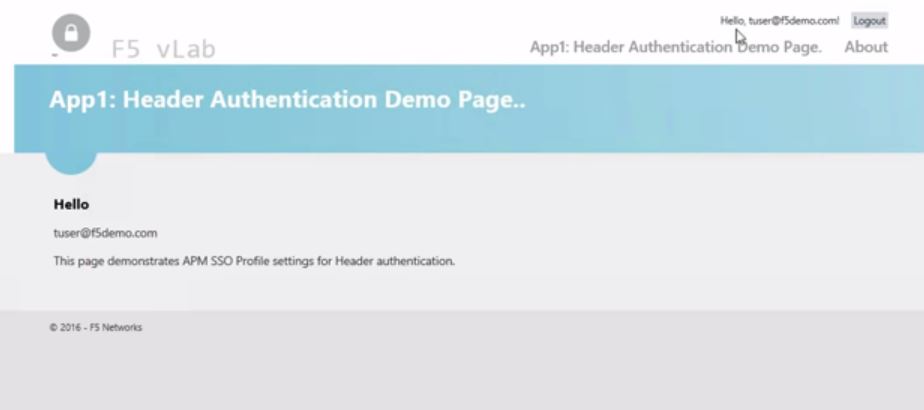
We’ll test the Header authentication first and see that we’re logged into App1 using Header authentication. Tuser@f5demo.com was the account we logged into with Okta and we see the application has been single-signed into using that credential.

Now let’s hit that Kerberos auth application. Here again, we’ve been SSO’d into the application. You may notice that the user looks a bit different here as F5DEMO\tuser since this time we used Kerberos Constrained Delegation. So, we’ve obtained a Kerberos ticket from the domain controller for F5DEMO as the user to use. So the username can look a little different but it’s mainly about formatting.


BIG-IP is able to consume that SAML assertion from Okta and then use SSO capabilities via Header or Kerberos for legacy applications. Watch Cody Green’s excellent demo of this integration.

ps

Tuesday, September 14, 2010

Audio Tech Brief - Authentication 101

Authentication is a growing requirement in this new era of heightened technology security. What is authentication and how can it be implemented in your environment to meet all of your application needs?  Running Time: 20:32  Read full white paper here.  And click here for more F5 Audio.

ps

twitter: @psilvas

Technorati Tags: F5, infrastructure 2.0, integration, cloud connect, Pete Silva, security, business, education, technology, application delivery, intercloud, cloud, context-aware, infrastructure 2.0, automation, web, internet

Posted via email from psilva's prophecies

Thursday, August 19, 2010

Audio Tech Brief - Kerberos Constrained Delegation and Protocol Transition in Smart Card PKI Architectures

Using the F5 BIG-IP Local Traffic Manager to support federation of cross-domain service access in a Smart Card PKI-enabled architecture.  F5 BIG-IP LTM with ACA in Kerberos protocol transition and constrained delegation architectures allows for a more scalable, efficient and secure infrastructure capable of federating access to services across domains and authentication realms, ultimately decreasing the capital and operational expenditures required to keep applications secure, fast, and available.  Running time: 16:20   Read full white paper here.  And click here for more F5 Audio.


ps

twitter: @psilvas

Technorati Tags: F5, infrastructure 2.0, integration, cloud connect, Pete Silva, security, business, education, technology, application delivery, intercloud, cloud, context-aware, infrastructure 2.0, automation, web, internet

Posted via email from psilva's prophecies

Friday, June 25, 2010

Audio Tech Brief - Constrained Delegation in CAC PKI Architectures

Kerberos has long been considered to reside at the top of the network authentication protocol tree as the most secure and, unfortunately, most complex authentication system. This comes not from the way in which Kerberos is designed, but rather from the complexity of the systems that have grown up around Kerberos that support identity management, especially when applied across organizational boundaries.  Using the F5 BIG-IP Local Traffic Manager to support federation of cross-domain service access in a PKI-enabled architecture.  Running time: 16:20   Read full white paper here.

And click here for more F5 Audio.

ps

twitter: @psilvas

Technorati Tags: F5, infrastructure 2.0, integration, cloud connect, Pete Silva, security, business, education, technology, application delivery, intercloud, cloud, context-aware, infrastructure 2.0, automation, web, internet

Posted via email from psilva's prophecies